
The History of the Jet Engine
Before the Jet Engine: The Search for Faster Flight
In the first decades of powered flight, the propeller was almost inseparable from the aeroplane. An engine turned its blades, the blades pushed air backwards, and the aircraft moved forwards. The arrangement carried aviation from the first tentative flights to increasingly capable airliners and military aircraft. As designers sought greater speed and altitude, however, its limits became harder to ignore. The tips of a rapidly turning propeller could approach the speed of sound even when the aircraft itself was flying much more slowly. Efficiency suffered, and simply fitting a bigger piston engine did not offer an unlimited route to faster flight.
The alternative began with a simple principle: an aircraft can move forwards by accelerating air backwards. A jet engine does this without relying on a large external propeller. Air enters an intake, is compressed, mixed with fuel and burned. Hot gas expands through a turbine, which drives the compressor, before leaving through a nozzle. The resulting flow produces thrust. Turning that sequence into a compact, reliable aircraft engine was considerably harder than describing it. The compressor had to deliver enough pressure, combustion had to remain stable in a rushing airflow, and the turbine had to survive intense heat while extracting enough power to keep everything running.
The idea of using reaction to create motion was centuries old, and gas turbines had been explored before aeroplanes became practical. The crucial aviation question was whether a turbine could be made light and efficient enough to fly. Early industrial machines were heavy, while materials and manufacturing methods struggled with the temperatures and rotational speeds required. Designers needed advances in metallurgy, aerodynamics and precision engineering as much as they needed a clever layout on paper.
Nor was every aircraft driven by a hot exhaust a turbojet. Rockets carry their own oxidiser and do not need to draw air through a compressor. A turbojet takes oxygen from the atmosphere and uses some of the energy released by burning fuel to spin its compressor. That distinction made it suitable for sustained atmospheric flight, although it also meant that its performance depended on carefully balancing all the parts of one continuous cycle.
By the late 1920s, aviation had reached the point where these obstacles looked formidable but perhaps solvable. Aircraft were faster, engineering knowledge was improving, and the reward for dispensing with a propeller was becoming clearer. Two researchers working independently, one in Britain and one in Germany, would turn that possibility into competing lines of practical development. Neither would find the path straightforward.
The aim was never simply to bolt a novel motor onto an existing aeroplane. A different source of thrust would affect the shape of the entire aircraft, from its air intakes to the space available for fuel. That made propulsion research inseparable from the future of aircraft design.
Frank Whittle and Hans von Ohain: Two Paths to Jet Propulsion
Frank Whittle was an officer in the Royal Air Force when he began developing his ideas for high-speed flight. He envisaged an aircraft gas turbine that would compress air, burn fuel and expel exhaust to generate thrust. He filed a British patent application in 1930. A patent, though, was not an engine. The concept demanded money, manufacturing expertise and a way to show that the machinery would continue operating once lit. For several years, Whittle struggled to win sustained official support.
In 1936, a private company, Power Jets, was formed to develop his design. It worked with British Thomson-Houston to build an experimental engine known as the Whittle Unit. The unit first ran in April 1937. Early tests brought the sort of problems that accompany an unfamiliar machine: controlling its behaviour, improving combustion and keeping components working under demanding conditions. The ground runs did not yet prove that an aircraft could fly on jet power, but they showed that the basic cycle was more than a drawing.
Meanwhile, Hans von Ohain was pursuing an independent approach in Germany. His work attracted the attention of aircraft manufacturer Ernst Heinkel, who backed the development of a small jet engine and a purpose-built aeroplane. Von Ohain and Whittle arrived at broadly similar solutions to the same propulsion problem without working together. They did not build identical engines: the details of their compressors, combustion arrangements and development programmes differed. Their shared achievement was to make a gas turbine into a plausible source of aircraft thrust.
Both pioneers initially used centrifugal compressors. In this design, a spinning impeller flings incoming air outwards to raise its pressure. The arrangement could be comparatively manageable for an early experimental engine, though the compressor’s shape made it difficult to package in a slender aircraft as designers sought greater power. Another approach, the axial compressor, moved air through successive rows of blades along the engine’s length. It would become especially important as engines grew more powerful, but it brought its own difficult aerodynamic and manufacturing problems.
The two development efforts advanced against a backdrop of uncertainty. An engine that ran on a test bed might overheat, surge, lose power or fail once placed in an aeroplane. Fuel supply, controls, intakes and exhaust arrangements all needed to work with the aircraft around them. Wartime urgency would soon give jet projects more resources, yet it would also place severe demands on their reliability. First, the engineers had to answer the simplest question of all: could one of these machines actually keep an aircraft in the air?
Even the word “jet” could hide a great deal of engineering. A convincing engine needed not only to produce thrust but to produce enough of it after accounting for its own weight and fuel needs. Bench testing narrowed the unknowns; it could not remove the risks of flight.
The First Jet Aircraft Take Flight
The answer came in Germany. On 27 August 1939, the Heinkel He 178 flew with a Heinkel HeS 3B engine developed through von Ohain’s programme. Its flight is generally recognised as the first by an aircraft powered by a turbojet. The achievement arrived only days before the outbreak of the Second World War in Europe. The He 178 was an experimental aircraft, not an operational fighter or a passenger service, and its success did not mean jet propulsion was ready for mass production.
The British breakthrough came later. On 15 May 1941, test pilot Gerry Sayer flew the Gloster E.28/39 at RAF Cranwell with an engine from Whittle’s development programme. The aircraft had been designed to put the new powerplant in the air and establish how a jet-propelled machine behaved in flight. Germany had achieved the first turbojet flight; Britain’s test confirmed the viability of its own independently developed engine. Those are different milestones, both central to the history.
The early aircraft looked strikingly simple beside many propeller-driven contemporaries, but a working jet created new engineering demands. Its intake had to feed the engine smoothly through changes in speed and attitude. Hot exhaust had to leave without damaging the airframe. Pilots had to learn how quickly, or slowly, thrust responded when they moved the controls. The aircraft also needed to take off and land safely despite an engine optimised for a very different style of flight from the familiar piston aeroplane.
One test flight rarely settled anything. Engineers had to discover how engines behaved over repeated starts, climbs and descents. They measured temperatures, fuel use and mechanical wear, then changed components and tried again. An experimental machine could fly impressively for a short time while remaining unsuitable for everyday operations. Reliability and service life mattered as much as a headline top speed. Those requirements would become more urgent when aircraft moved from controlled trials to airfields operating in wartime.
The He 178 and E.28/39 were therefore stepping stones, not finished answers. They showed that the turbine could replace the propeller as a direct source of thrust and opened the way to larger, more capable engines. They also revealed how much work lay between proving a principle and producing a useful aeroplane. By the early 1940s, designers were building jet-powered aircraft for military roles. Their engines would now be judged under conditions that allowed little room for fragile prototypes.
Neither first flight settled which country had built the better long-term engine. Different teams would make different choices about compressors, airframe layout and production. The more revealing test was whether mechanics could keep an aircraft serviceable and whether pilots could trust it repeatedly, not merely on a carefully prepared demonstration.
War Accelerates Jet Engine Development
During the Second World War, jet propulsion moved from isolated experiments towards operational aircraft. Germany’s Messerschmitt Me 262 flew under jet power alone in 1942 and saw combat in 1944. Its engines used axial compressors, a different route from the centrifugal designs of the earliest successful flights. In Britain, the twin-engined Gloster Meteor entered RAF service in 1944. Its appearance confirmed that the jet was no longer confined to a test programme, even though the two aircraft served under very different operational circumstances.
The promise was unmistakable. Jets could achieve speeds beyond those available to many piston-engined fighters, changing the problems faced by pilots, aircraft designers and air defences. Yet the engine was still a demanding machine. German jet development, in particular, faced shortages of materials suitable for hot turbine components. Engines with limited working lives required maintenance and replacement, while aircraft production, fuel supply and pilot training also shaped what the new technology could accomplish. Greater speed alone could not overcome those constraints.
Britain’s Meteor provided a different lesson. Its early service demonstrated that a jet fighter could be integrated into military operations, initially including the interception of V-1 flying bombs. Engines continued to change as manufacturers worked to produce more thrust and improve reliability. The early British preference for centrifugal compressors reflected a practical development path rather than a permanent verdict on compressor design. As engineers learned to manage airflow through successive rows of blades, axial compressors offered a way to build more powerful engines with a smaller frontal area.
The war also carried jet knowledge across national borders. Britain shared engine technology with the United States, where General Electric developed engines drawing on Whittle’s work. American aircraft manufacturers began their own flight programmes. After the war, engineers and governments studied German designs and personnel as well. Jet development became an international undertaking, with different firms testing solutions to compression, combustion, cooling and turbine life.
For all the attention paid to pioneering aircraft, the engine was the difficult part to turn into a dependable product. Repeated high-temperature operation could exhaust components long before an airframe wore out. Manufacturers needed better alloys, better blades, tighter production tolerances and maintenance routines that could identify trouble before an engine failed. Wartime programmes accelerated those advances, but peace would present a new challenge. The next generation of operators would want engines that ran for long periods, carried paying passengers and could be maintained economically. The jet had to become an ordinary piece of transport machinery.
That transition also changed what counted as success. An experimental fighter might justify intensive attention from a ground crew before each sortie. A commercial aircraft had to depart on schedule, fly safely for years and keep costs under control. The technology now faced a far more public examination.
From Military Jets to the Passenger Jet Age
After 1945, jet engines found a market that rewarded more than raw speed. Airlines wanted aircraft that could travel farther and faster while carrying passengers comfortably and earning money on regular schedules. The de Havilland Comet made the decisive public leap. It first flew in 1949 and entered BOAC service on 2 May 1952 as the first commercial jet airliner. Its four de Havilland Ghost turbojets helped bring a new style of flight to paying passengers: smoother travel above much of the weather and shorter journeys than contemporary piston airliners could offer on many routes.
The Comet’s history also shows why a jet engine alone did not make a successful airliner. A series of accidents led investigators to identify fatigue cracking in the pressurised cabin. The resulting grounding and redesign concerned the aircraft’s structure, not a failure of the basic jet propulsion principle. Lessons from those investigations influenced later airliner design and testing. Meanwhile, engine manufacturers continued to seek better fuel consumption and longer service life, because an airline had to pay for every hour in the air and every hour an aircraft spent unavailable for maintenance.
The Boeing 707’s entry into airline service in 1958 helped make the jet a familiar presence on international routes. Its early Pratt & Whitney JT3 turbojets descended from a family developed for both military and civil use. Other aircraft and engine makers competed to serve the growing market. Jets offered speed, but early turbojets could be noisy and thirsty, especially when judged against the needs of expanding airline networks. The question was shifting from whether jets could carry passengers to how efficiently they could do so.
One answer was to use the gas turbine in another way. In a turboprop, the turbine drives a propeller, which produces most of the thrust. It remained valuable where fuel economy and performance at moderate speeds mattered more than jet-airliner cruising speed. A second answer was the turbofan: a turbine drives a fan that sends some air around the hot engine core. That bypass air also produces thrust. Engineers could therefore move a larger mass of air by a smaller amount, rather than relying only on a relatively narrow, fast exhaust stream.
The first generation of turbofans had modest bypass ratios, but it pointed towards quieter, more economical passenger aircraft. Engines such as the Rolls-Royce Conway and Pratt & Whitney JT3D brought the principle into commercial service around the turn of the 1960s. Civil aviation had taken the turbojet from experimental promise to scheduled transport in just over a decade. The next leap would make the fan larger still, reshaping both engines and airliners.
For passengers, these shifts were experienced less as a technical revolution than as a change in the journey itself. Routes could be flown faster, and the economics of larger aircraft gradually opened air travel to wider groups. The improvements depended on airframes, airports and airlines as well as engines.
The Turbofan and the Engines That Power Modern Aviation
From the late 1960s, high-bypass turbofans transformed passenger flight. A much larger fan moved substantial air around the engine core, producing a greater share of the thrust. This improved fuel efficiency at the speeds flown by airliners and reduced the sharp exhaust noise associated with early turbojets. The engine’s familiar wide front opening became a defining feature of the modern passenger aircraft. Wide-body airliners, including the Boeing 747, helped establish a market for these powerful engines.
Progress came through many small changes as well as conspicuous new models. Engineers raised compressor efficiency, improved the shapes and cooling of turbine blades, developed materials able to withstand higher temperatures and refined electronic engine controls. Better manufacturing and maintenance extended useful operating life. These advances allowed engines to produce more thrust while using less fuel for the work they performed. Aircraft manufacturers could build long-range twin-engined airliners as engine reliability, performance and operating rules developed together.
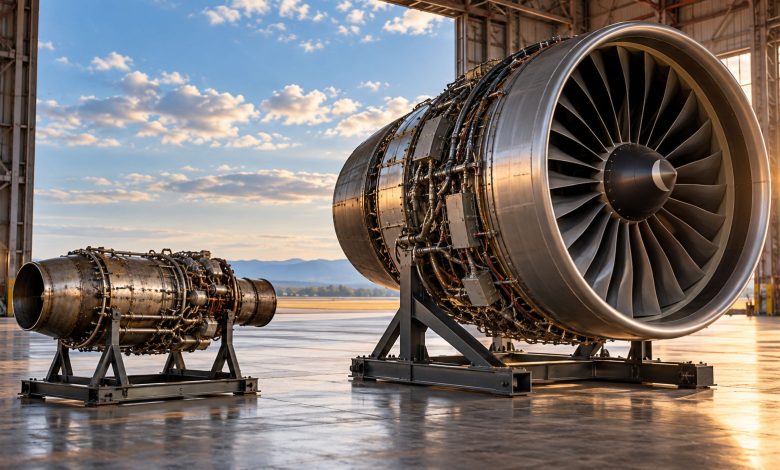
The distinction between an early turbojet and a modern high-bypass turbofan is visible even from outside an airport fence. Both use a gas turbine core, but a modern airliner’s large fan accounts for much of its thrust. The bypass ratio describes how much air goes around the core compared with how much flows through it. A higher ratio is often useful for efficient subsonic transport, although the best arrangement depends on the aircraft and its mission. Fast military aircraft may use lower-bypass engines and, in some cases, afterburners, trading fuel economy for different performance demands.
The Rolls-Royce Trent XWB, developed for the Airbus A350, shows how far the idea has travelled since the first fragile turbines. Today’s engines are designed alongside the aircraft they will power, with attention to weight, fuel burn, noise, emissions and long-term maintenance. Development continues: Rolls-Royce has run its UltraFan demonstrator, while NASA and industry partners are researching further improvements to engine cores and fan arrangements. A demonstrator is a test of technology, however, rather than an engine already carrying airline passengers.
The basic cycle that Whittle and von Ohain worked to make practical remains recognisable. Air is compressed, fuel burns, a turbine turns and thrust carries the aircraft forwards. Nearly ninety years after the first turbojet flight, the questions are different. Designers are trying to extract more useful work from each kilogram of fuel while reducing noise and environmental impact. The jet engine did more than make aircraft faster: through decades of refinement, it changed which journeys were practical for millions of people. Its history continues each time a new engine is tested, certified and put to work.
Fuel use is also an environmental concern, so efficiency gains remain valuable even when passenger demand grows. Designers must weigh those gains against the cost, size and complexity of a new engine. The search that began with experimental turbines now unfolds through enormous research programmes and years of testing.