
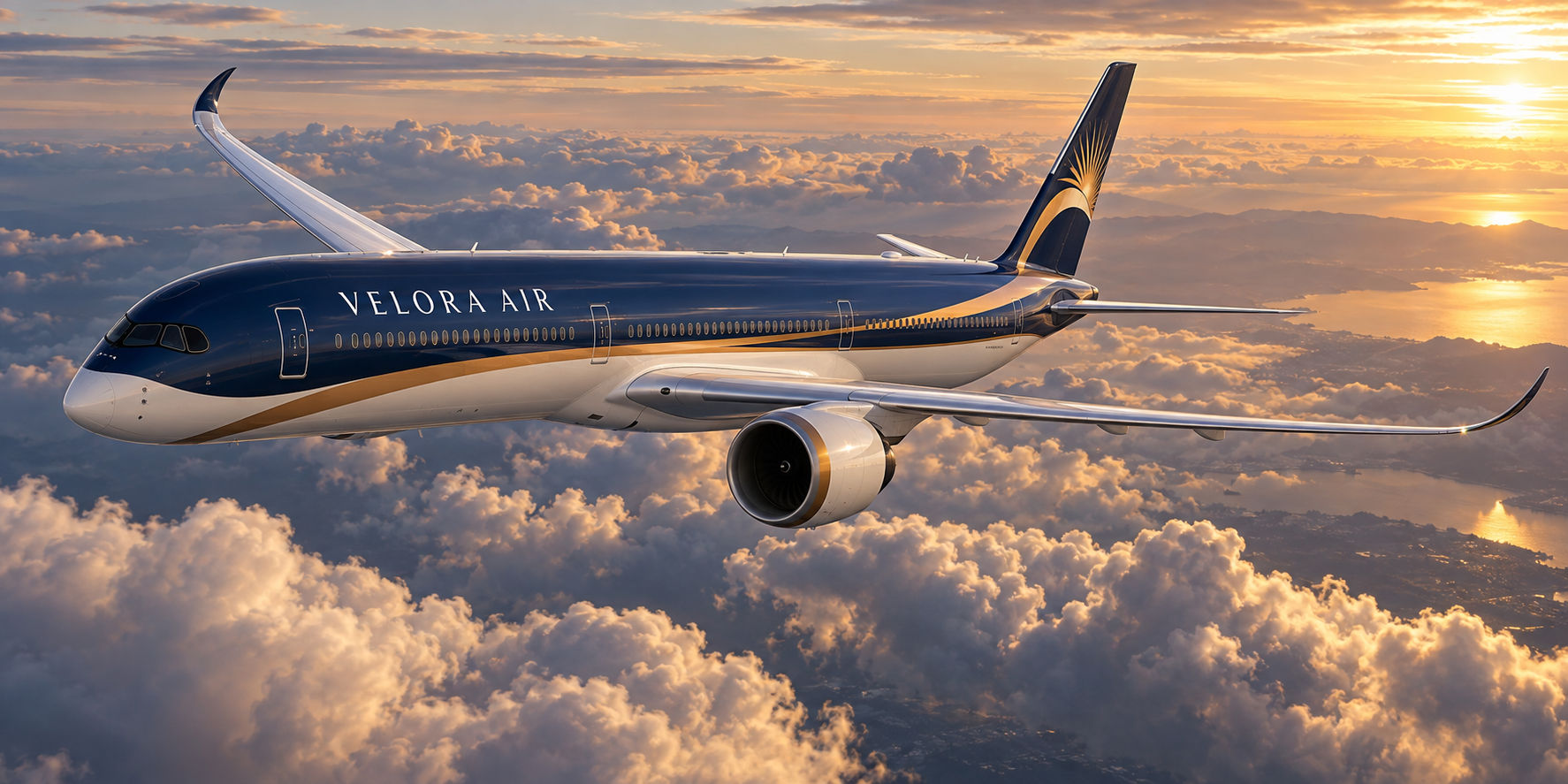
The Airbus A350 is a long-range, twin-engine airliner designed to carry passengers across continents. Its swept wings, curved wingtips and dark outline around the cockpit windows make it one of the more recognisable aircraft in the sky. Beneath that appearance is an aircraft built around a modern composite structure, purpose-designed Rolls-Royce engines and a cabin intended for long flights. The family includes the A350-900 and the larger A350-1000, alongside specialised ultra-long-range versions.
From development to first flight
Airbus developed the A350 to give airlines a new-generation aircraft for long-haul routes. Rather than relying on an older widebody airframe, the finished A350 received a new fuselage and wing designed for the demands of extended twin-engine flights. Carbon-fibre-reinforced plastic accounts for a substantial share of its structure; Airbus puts composite materials at 53 per cent of the airframe. Reducing weight was one part of the design, alongside aerodynamic improvements and the ability to carry large loads of passengers and fuel efficiently.
The first A350-900 flew from Toulouse on 14 June 2013. That flight began a test campaign covering the aircraft’s handling, systems and performance before it could carry paying passengers. Qatar Airways received the first production A350 in December 2014 and introduced the -900 into commercial service in January 2015. The gap between first flight and first airline service reflects how much proving work lies behind a new passenger aircraft, even after it has flown successfully.
How the A350 is built
The A350 is a twin-aisle aircraft with two Rolls-Royce Trent XWB turbofan engines, one beneath each wing. Rolls-Royce developed the engine specifically for the A350 family. The A350-900 uses the Trent XWB-84, while the heavier A350-1000 uses the more powerful Trent XWB-97. From the cabin, passengers may notice the aircraft’s large windows, high ceilings and lighting designed to make long journeys more comfortable. For an airline, the important calculation is how efficiently it can fly a particular route with the seats, cargo and fuel required.
The aircraft is assembled in Toulouse, but its major components come from several locations. Airbus says its wings are built in Broughton in the UK, fuselage sections are produced in Germany and France, and horizontal tailplanes come from Spain. That international production chain is characteristic of Airbus, although passengers encounter its results as a single aircraft at the gate.
One family, two principal sizes
The A350-900 is the original passenger version. Airbus lists it at 66.8 metres long, with a typical three-class cabin of around 332 to 352 seats. Its size gives airlines room for a substantial long-haul cabin without committing to the capacity of the larger model. An ultra-long-range version of the -900 can carry additional fuel for exceptionally long non-stop services, though its cabin arrangement and operating requirements differ from those of a standard aircraft.
The A350-1000 stretches to 73.8 metres and typically seats around 375 to 400 passengers in a three-class arrangement. It shares much of the -900’s design but has more powerful engines and is intended to carry more passengers on demanding long-haul routes. Its first flight took place in November 2016. Qatar Airways received the first example in February 2018, giving airlines a second size within the A350 family. Both principal versions have a wingspan of 64.75 metres. Actual seating and achievable range depend on an airline’s chosen configuration and operating conditions.
Airbus is extending the family further. An A350-1000ULR intended for Qantas’s exceptionally long proposed routes made its first flight in June 2026. Airbus is also developing the A350F, a dedicated freighter. These aircraft belong in the A350 story, but they should not be confused with the standard passenger -900 and -1000 already in airline service.
The A350 in airline service
The A350 has become a familiar sight on international routes, carrying passengers between major cities while also giving airlines flexibility to serve less heavily travelled long-haul markets. Its two main passenger versions let operators choose between different capacities while retaining a closely related fleet. Airbus reported in June 2026 that more than 700 A350s were flying with 41 operators, principally on long-haul services. That figure will change as deliveries continue, but it shows how far the aircraft has travelled from its first test flight over Toulouse.
The A350’s place in aviation is broader than a single range or seating figure. It represents the shift towards long-range twin-engine aircraft that can connect distant cities while using less fuel than the widebodies they replace. The exact savings vary with the aircraft and route being compared. What is clear is that Airbus designed the A350 as a family: the -900 and -1000 serve different capacity needs, while newer specialised versions push the design towards longer flights and freight operations.