
Agusta’s Ambition to Build an Original Helicopter
Before the AW109 became a familiar sight above cities and landing pads, its maker faced a different challenge: how to become a designer of helicopters in its own right. Agusta had experience building and supporting rotorcraft, including types developed elsewhere. That work taught its engineers about production, maintenance and the demands of customers. Creating an original machine meant assuming responsibility for everything from the rotor and transmission to flight testing, certification and long-term support. Success could give the Italian company an identity in a competitive international market.
The idea that led to the A109 took shape at the end of the 1960s. Agusta designer Bruno Lovera sought approval from company leader Domenico Agusta to develop prototypes for a new helicopter. The proposed aircraft would be relatively small but capable, with two turbine engines and the flexibility to serve more than one kind of customer. Choosing a twin-engined layout brought the appeal of additional power and redundancy, though it also made the aircraft more complex and costly than a simpler single-engined machine. Agusta needed a design whose performance and versatility justified that decision.
Its engineers also had to decide how the helicopter would present itself to operators. The emerging A109 combined a streamlined fuselage with a retractable wheeled undercarriage, a distinctive choice for a light helicopter. Retracting the wheels reduced drag in forward flight and helped the machine’s clean appearance, but added mechanical systems and maintenance demands. The cabin needed to accommodate passengers or specialist equipment without turning the helicopter into something too large for the roles it was intended to fill.
The rotor system was another central choice. Agusta used a four-bladed articulated main rotor and a two-bladed tail rotor on the early design. These components were not decorative details: they determined handling, vibration, control and the loads carried through the airframe. Designers had to bring together performance, acceptable noise and a manageable workload for the pilot. A promising configuration on a drawing board would still need extensive tests in flight and on the ground.
Agusta authorised prototypes and began turning the concept into hardware. The early project was more than a search for one prestigious sale. It was a test of whether an Italian manufacturer could design a helicopter, prove it to regulators and build a product family that operators would continue to buy. First, however, the new aircraft had to lift off safely. The maiden flight would begin a lengthy process of refinement rather than complete it.
At that stage Agusta had no assurance that certification would follow or that operators would buy enough aircraft to recover development costs. The risk was precisely what made the project significant. If it worked, the company could offer its own design to customers instead of depending principally on someone else’s helicopter programme.
The A109 Takes Flight and Wins Certification
On 4 August 1971, test pilot Ottorino Lancia took an A109 prototype into the air. Leonardo describes the helicopter as the first entirely Italian-designed twin-engined helicopter. For Agusta, the flight demonstrated that its design team had made the transition from licensed production to an original flying machine. Observations during the early trials pointed to manoeuvrability and relatively low levels of noise and vibration, qualities that would matter to both pilots and passengers.
The aircraft that first flew was still a prototype. Flight testing had to establish how it behaved across a range of speeds, weights and conditions. Engineers examined the helicopter’s controls, rotor and transmission, monitored its engines and refined the shape and equipment of the production aircraft. A report issued in September 1971 set out drawings for the final version. There was a substantial distance between proving that a prototype could fly and demonstrating that customers could operate one routinely.
The original A109 used two Allison 250-C20 turboshaft engines. A turboshaft converts much of its energy into shaft power to turn the rotor rather than producing thrust directly from exhaust, as a turbojet does. Its main rotor provided lift and much of the forward motion when the helicopter tilted; the tail rotor countered the turning force from the main rotor and helped control direction. Retractable wheeled landing gear contributed to the aircraft’s sleek outline in flight, one of the features that made the A109 easy to recognise.
Certification provided the decisive bridge from prototype to sale. The Italian Aeronautical Register approved the A109 in 1975, followed by the United States Federal Aviation Administration. The original certified aircraft was described as having eight seats including the pilot, with a maximum weight of 2,400 kilograms. Those figures describe the early version; they should not be applied without qualification to every later AW109. Approval in the United States opened a particularly important market to an Italian-designed aircraft.
Deliveries began in 1976. That milestone mattered at least as much commercially as the first flight. Agusta now had to supply aircraft built to an approved standard, provide spares and training, and answer customers’ questions after delivery. Each operator would test whether the A109 was genuinely useful beyond the demonstration circuit. Its compact dimensions, performance and cabin flexibility offered promising foundations, but sustained service would decide whether the helicopter was a lasting design or simply a bold first effort.
The first deliveries also gave Agusta feedback unavailable from test flying alone. Customers would operate from different airfields and landing sites, carry varied loads and report what wore out or proved awkward. That experience could inform later improvements and help build confidence in a helicopter designed well beyond its maker’s domestic market for demanding international operators.
Finding Its Place in Civil and Public Service Aviation
As A109s entered service, their buyers began to show what the design could do. Government and paramilitary customers were among the first recipients, in Italy and abroad. Public agencies could use a helicopter to reach places quickly, observe activity from above or move personnel without depending on roads. A light twin-engined aircraft offered a different balance of speed, cabin space and operating needs from larger transport helicopters. The A109’s usefulness lay in that balance, rather than in one narrowly defined mission.
Civil operators also saw opportunities. Executive passengers valued a relatively fast helicopter capable of reaching locations where fixed-wing aircraft could not land. Medical and rescue organisations could configure the cabin around equipment and personnel, subject to the limitations of each version. Police and government users had other needs, including communications, observation equipment and the ability to operate from varied sites. These roles required different interiors and support arrangements; an A109 fitted for executive travel was not automatically ready to serve as an air ambulance.
Operating a helicopter demands more than fitting the right seats. Crew training, weather limits, landing-site suitability and maintenance all shape whether it can perform a particular job. A twin-engined design provides options in the event of an engine failure, but the available performance depends on the aircraft’s weight and the conditions in which it flies. Operators therefore had to assess the A109 against their actual routes and missions rather than a single brochure figure. This is particularly important when comparing machines built decades apart.
Agusta also needed to support an international customer base. Obtaining United States certification did not by itself create a network of parts, technical advice and maintenance. The company developed its presence abroad, including support activity in Philadelphia that later grew into a broader manufacturing and service footprint. The A109’s ability to attract customers outside Italy helped make that investment worthwhile. For a manufacturer seeking a global position, supporting aircraft in service was part of selling the next one.
The helicopter’s first years established something that is easy to miss when looking at later, more powerful variants. The original design had room to develop. Different customers wanted changes to engines, equipment, payload and cockpit systems, but the underlying idea remained attractive: a compact twin-engined helicopter with useful speed and a versatile cabin. Those requests would push Agusta to improve the design rather than leave the 1970s aircraft untouched. The name A109 would come to describe an evolving family, and its specifications would gradually move beyond the figures recorded on the first certificate.
The breadth of work also explains why photographs can be misleading. The same outline might conceal a different interior, communications fit or approved payload. An aircraft’s registration, version and operator records offer more useful evidence than its paintwork when determining exactly what it could do at a particular time.
New Engines and New Roles: The A109 Evolves
Once a helicopter has proved itself with operators, its manufacturer faces a difficult choice. Keeping the design unchanged can make it familiar and straightforward to support, but customers may want greater capability as equipment and operating expectations change. Agusta followed a path of continuing development. Successive A109 versions incorporated changes to engines, systems and the airframe, while specialised configurations served government and military users alongside civilian customers. The family kept a recognisable identity even as the details changed.
Engine choice was especially consequential. Power affects how much a helicopter can carry, the conditions in which it can operate and its performance if one engine fails. A new engine is not a simple bolt-on improvement, however. It must be matched to the transmission and aircraft systems, tested and approved. The A109 Power, associated with the A109E designation, became an important later member of the family. It offered customers a substantially updated light twin rather than the original 1970s specification with a new label.
Cockpit technology changed too. Earlier helicopters relied more heavily on individual instruments, while later models moved towards integrated displays and improved navigation equipment. These changes could help crews manage information, particularly on demanding missions, but they also brought new training and certification needs. Operators buying helicopters over several years might find that two aircraft carrying the same family name required different procedures or had different equipment. Variant names and individual airframe records therefore matter when discussing the AW109.
The longer-cabin Grand developed the idea further. Compared with earlier members, it offered more room for passengers or role equipment and reflected demand for a light helicopter able to undertake more substantial transport and service work. These developments did not turn every A109 into one standard machine. A medical interior, a corporate cabin and a government fit could differ markedly even within the same named variant. The continuing attraction was the ability to adapt a proven concept to changing needs.
Corporate names also began to change around the helicopter. Agusta joined with Britain’s Westland in AgustaWestland in 2000, and Finmeccanica became sole owner of the joint venture in 2004. Aircraft previously called Agusta A109s appeared in later material as AgustaWestland AW109s. The difference reflects the manufacturer’s history, not a sudden break between unrelated helicopter types. As the new century advanced, further cockpit and airframe improvements would produce the GrandNew, while a version with a conspicuously different landing arrangement would extend the family into new operating roles.
The names Power and Grand signalled genuine development, but they do not form a simple ladder in which every later aircraft replaced every earlier one. Customers could choose a version suited to their needs and continue flying older machines. That coexistence is another reason to keep dates and specifications attached to particular models.
From AgustaWestland to Leonardo: Power, GrandNew and Trekker
By the 2010s, the AW109 label covered helicopters with quite different equipment and operating characteristics. The GrandNew developed the larger-cabin branch with updated avionics. Leonardo lists it with two Pratt & Whitney Canada PW207C engines, an overall length of 12.96 metres with the rotor turning and a main rotor diameter of 10.83 metres. Its published capacity is one or two crew and up to six passengers. These are GrandNew figures, useful for describing that variant but unsuitable as exact dimensions or capacity for every A109 built since 1971.
The Trekker took another approach. Earlier members of the family were closely associated with retractable wheels; the AW109 Trekker used skid landing gear. Skids offered a configuration suited to utility and public-service work while retaining the broad family heritage. The aircraft also received a modern cockpit and could be equipped for missions ranging from passenger transport to emergency medical and search work. The change is visible at a glance, making it a good reminder that the AW109 is a family of related helicopters rather than one unchanging model.
Leonardo announced European certification of the Trekker in December 2017, with deliveries scheduled to begin in 2018. Its published configuration included two PW207C engines, a cabin accommodating up to six passengers and optional mission equipment such as a rescue hoist, searchlight and emergency floats. Such equipment depends on the aircraft ordered and approved for a particular mission. An illustrated example carrying a hoist should not be taken to mean every Trekker has one.
The manufacturer’s identity changed again during this period. Finmeccanica reorganised its businesses in 2016 and adopted the Leonardo name in 2017. The AW109 designation remained in use, even though the company selling and supporting the helicopter was now Leonardo. A photograph labelled Agusta, AgustaWestland or Leonardo can therefore show an aircraft from the same continuing design lineage. For collectors of registrations and operators comparing specifications, the variant and date are much more revealing than the company name alone.
The GrandNew and Trekker also illustrate why a guide to the family should resist a single headline performance number. Under Leonardo’s stated test conditions, their published maximum cruise speeds are 153 and 148 knots respectively. Those figures are cruise speeds, not certified never-exceed speeds or universal maximums. Differences in weight, equipment, altitude and weather also affect real flights. A useful family guide should explain the options, then direct readers to the specific version’s documentation for an exact operating figure.
The differences also affect any comparison with competing helicopters. A cabin advertised with six passenger seats may carry fewer when fitted with medical equipment or when crew requirements change. Published range figures may assume auxiliary fuel and no reserve. The conditions printed beside a number are part of the specification, not small print to discard.
The AW109 Family in Service Today
More than half a century after the A109 first flew, members of its family continue to serve in varied roles. A passenger travelling in a carefully finished executive cabin may encounter a very different helicopter from the crew using a utility-configured Trekker. Emergency services, public agencies and private operators choose equipment to fit their tasks. The continuing appeal lies in the family’s ability to combine light twin-engined operation with cabins and systems adaptable to several kinds of work.
Its longevity does not mean the original model and a recent AW109 are technically identical. Engines, cockpits, airframe details, weights and approved equipment have changed over time. Leonardo’s current figures for the GrandNew and Trekker, for example, describe aircraft with a maximum internal gross weight of 3,175 kilograms, substantially above the 2,400 kilograms recorded for the original certified A109. A statement about “the AW109’s capacity” or “the AW109’s speed” needs a named variant and preferably the conditions under which the measurement was made.
The family also shows how an aircraft can outlive several names above the factory door. Agusta created the original machine; AgustaWestland developed and marketed later versions; Leonardo is the current certificate holder identified by the European aviation regulator. That succession has practical consequences for a guide directory. Listing an early A109 and a modern AW109 as entirely unrelated aircraft would make the development story harder to follow. Presenting them as one family allows readers to see both the continuity and the significant changes.
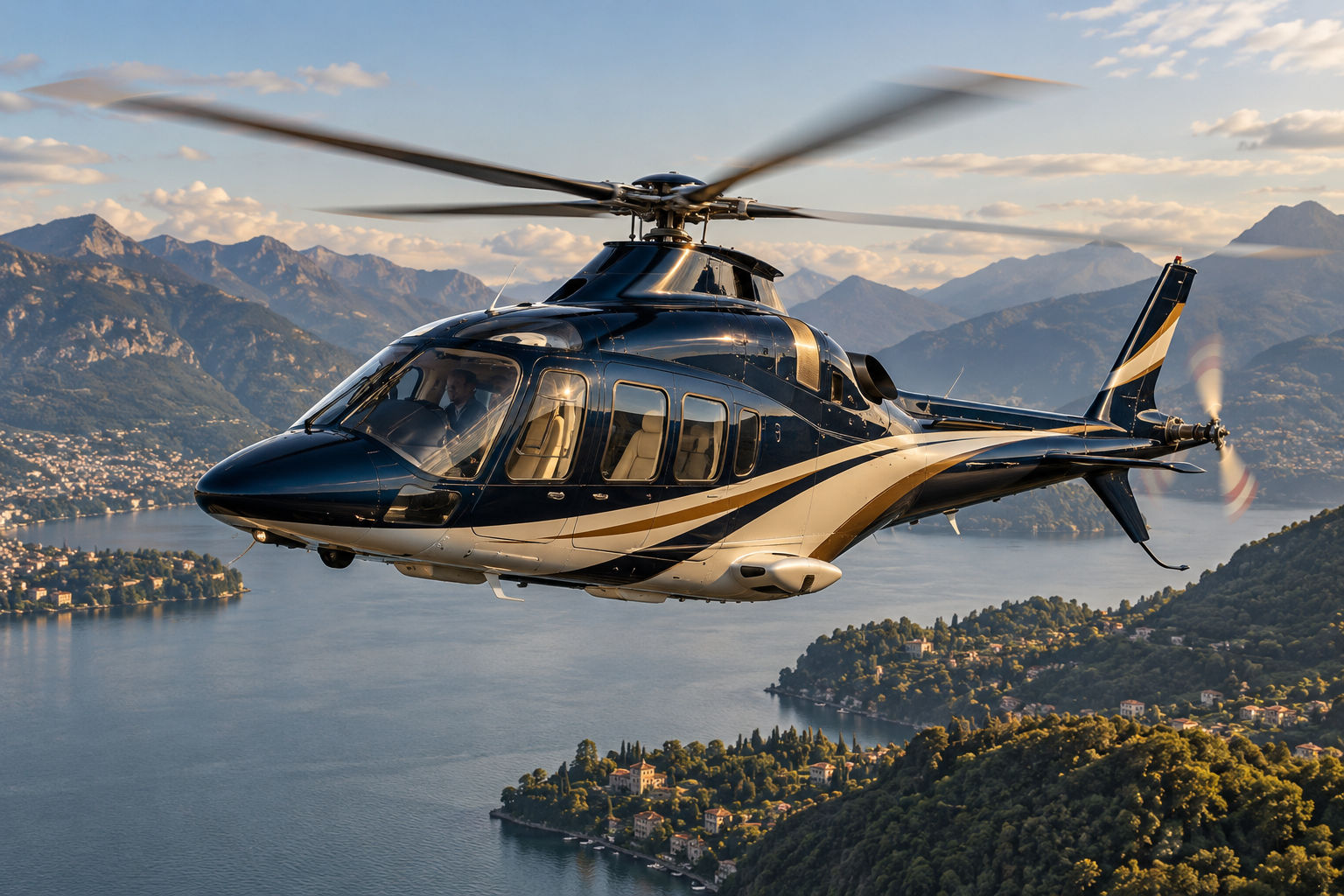
For anyone watching an AW109 fly, the obvious features may be its compact body, paired turbine engines and quick, purposeful movement. More careful inspection reveals differences. A wheeled GrandNew and a skid-equipped Trekker will not look the same on the ground. Their interiors can vary even more, from passenger seating to the equipment required for a specialist mission. None of that can be inferred reliably from the family name alone, and an AI-generated illustration should never be used as evidence of a particular real aircraft’s configuration.
Agusta began the project to prove it could create an original helicopter that customers would want. The first prototype flew in 1971, certification followed in 1975 and deliveries began the next year. Subsequent development turned a single Italian design into a long-running line of light twin-engined helicopters. Its history is not one uninterrupted set of specifications; it is a sequence of answers to changing needs. That makes the AW109 an excellent example of why this guide covers an aircraft family rather than publishing a separate introductory article for every variant.
Future entries can still go deeper where a variant has a distinct service story. The family guide provides the shared development path, while detailed comparisons belong in a variants table or a dedicated specialist article. Readers can then move from the 1971 prototype to a modern operator without confusing the earliest A109 with the helicopter they see today.