
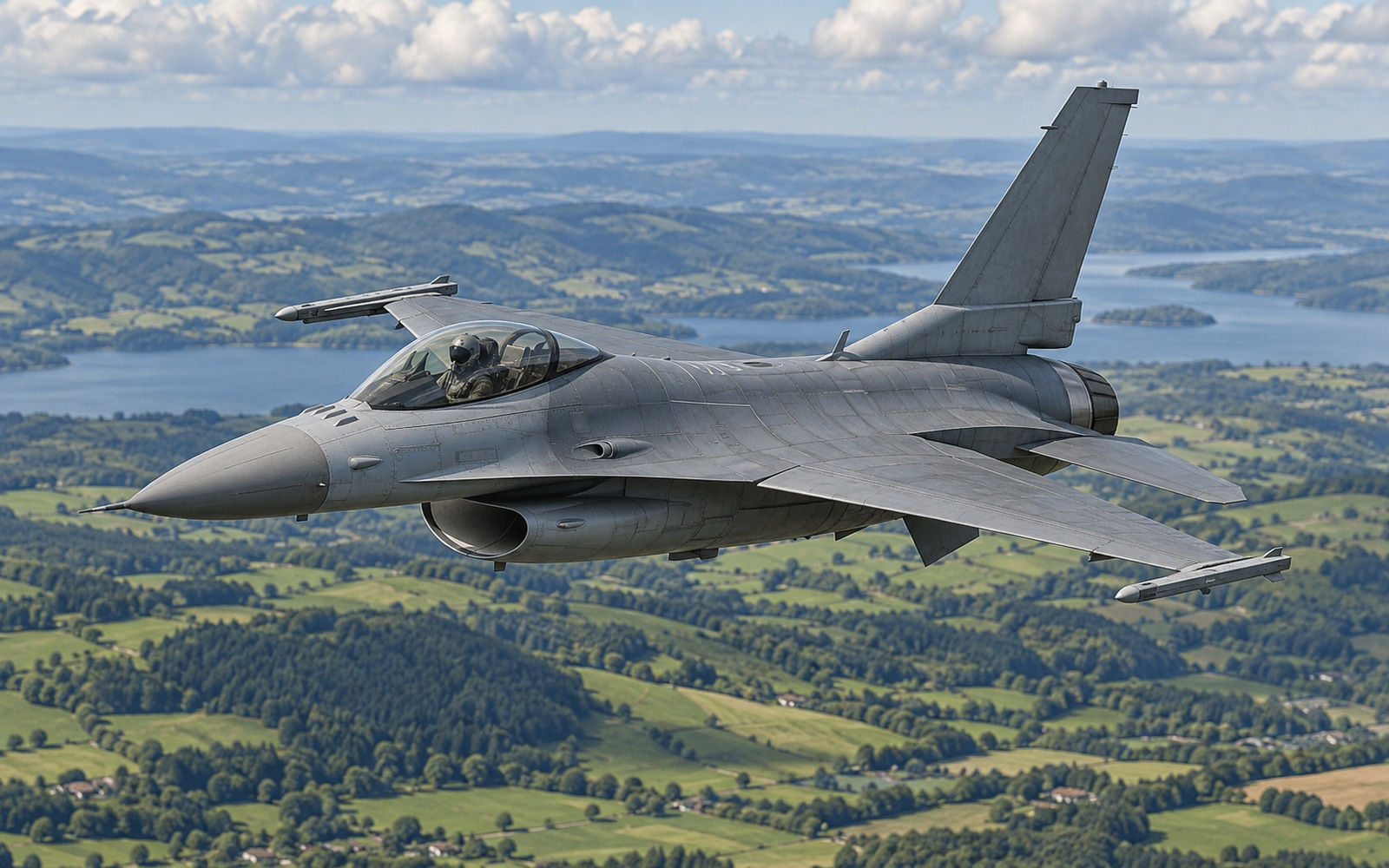
The aircraft that became the F-16 Fighting Falcon began with a debate about what a fighter should be. By the late 1960s, new combat aircraft had become increasingly heavy and complex. Some American officers and designers argued that manoeuvrability, visibility and an effective power-to-weight ratio deserved renewed attention. The US Air Force’s Lightweight Fighter programme gave industry a chance to test those ideas in the air. General Dynamics, then an independent manufacturer, developed the YF-16 demonstrator at its Fort Worth operation in Texas.
The General Dynamics team set out to make a small, single-engined fighter that could turn hard and respond quickly. One important choice was relaxed static stability: the aircraft was designed to be less naturally stable than a conventional aeroplane, allowing a quicker response to control inputs. Electronic fly-by-wire controls constantly helped keep it flying as intended. The pilot used a side-mounted control stick, while a large bubble canopy provided a wide view. These elements worked together. Removing one feature from the list would make it harder to understand why the design felt so different from earlier fighters.
The YF-16 also brought its engine, intake and wing into a compact shape. That did not mean development was simple. Engineers had to make the flight-control system trustworthy, establish the aircraft’s handling characteristics and show that the promised performance could be repeated outside a drawing office. Its rival in the competition was the Northrop YF-17. Both prototypes offered ways of answering the same broad requirement, and trials would decide which direction the Air Force wanted to pursue.
The YF-16 made an unexpected brief flight on 20 January 1974, when test pilot Phil Oestricher lifted off during a high-speed taxi test after the aircraft began to oscillate. The planned formal first flight followed in February. The distinction between those two events is useful: the unplanned take-off showed that the prototype could fly, while the subsequent test programme explored whether its design would meet the customer’s needs. A memorable incident did not, on its own, win a production contract.
After comparative evaluation, the US Air Force selected the YF-16 in 1975 for the Air Combat Fighter programme. The decision took the aircraft beyond a lightweight technology contest and towards a deployable fighter. The production F-16 would need the range, equipment and support required by operational units. Those demands inevitably added weight and complexity, but the essential design choices survived.
The F-16’s origins matter when identifying its maker. It was a General Dynamics project from concept through prototype and early production. Lockheed, and then Lockheed Martin, became associated with it much later through changes in ownership. The small fighter conceived in Fort Worth would prove adaptable enough to outlive the corporate structure in which it began.
Flight Testing, Production and Entry into Service
Winning the competition was only the beginning of turning the YF-16 into a service aircraft. General Dynamics had to develop a production design, manufacture it consistently and demonstrate that units could use it day after day. Testing went beyond maximum speed and turning performance. Pilots and engineers assessed the engine, flight controls, cockpit, weapons and the behaviour of the aircraft across its operating range. Ground crews had to learn how to inspect and maintain systems that differed from those on the fighters they already knew.
The single-seat F-16A became the initial operational version, with the two-seat F-16B serving training and other roles. The two-seat model was part of the same family, although its second cockpit affected internal space. Both versions kept the recognisable low-mounted wing, one engine and tall single fin. To people seeing the fighter from the ground, the large clear canopy was perhaps its most striking feature. To a pilot, it provided visibility that could be valuable when keeping track of another aircraft during a fast-moving encounter.
Fly-by-wire controls required particular confidence. The pilot’s side stick sent commands to computers rather than moving the control surfaces through a conventional direct mechanical linkage. The system continuously interpreted inputs and helped manage an aeroplane designed for agile handling. This approach offered advantages in manoeuvrability, but it also meant that electronic reliability and careful flight testing were fundamental to the aircraft’s safety and usefulness. The F-16 helped demonstrate that such controls could become normal equipment on an operational fighter.
The first operational F-16A was delivered to the US Air Force in January 1979, to the 388th Tactical Fighter Wing at Hill Air Force Base in Utah. Entry into service did not bring development to an end. Pilots needed tactics suited to the new aircraft, instructors had to train further crews, and maintainers had to build experience with its systems. Early squadrons also provided feedback about the gap between the performance shown in tests and the practical needs of routine operations.
The official name Fighting Falcon entered public use, although many pilots and crews would come to call the aircraft the Viper. Its compact shape and handling made it an appealing fighter, but an air force could not judge it on agility alone. It needed to reach a mission area, carry useful weapons, communicate with other forces and return to be readied again. These requirements shaped the production aircraft and made future growth possible.
By the end of the 1970s, the F-16 had crossed the difficult threshold from demonstrator to operational equipment. It remained closely associated with the lightweight-fighter idea, but was already more than an experiment in aerial manoeuvring. Orders from other countries soon turned it into an international programme with an industrial life far beyond Fort Worth.
Early Export Success and International Production
The F-16’s international story began early, not as an afterthought once the US Air Force had finished adopting it. Belgium, Denmark, the Netherlands and Norway selected the fighter, and arrangements for European production involved their industries alongside the American programme. International co-production was under way from the late 1970s. That meant the aircraft was entering a network of factories, air forces and training systems rather than leaving a single US assembly line for each new customer.
For the European buyers, sharing a fighter offered practical attractions. Neighbouring air forces could work towards common equipment and operating methods, while national industry gained a role in manufacture or assembly. The arrangement also brought challenges. Each country had its own procurement decisions, budgets and expectations. Keeping aircraft sufficiently alike to support joint operations required coordination between governments and manufacturers as well as agreements about parts and later improvements.
Other countries also ordered the F-16, widening the family of users. Operators used it for air defence, training and, increasingly, missions involving targets on the ground. The aircraft’s popularity did not mean that every air force flew an identical version. Equipment, weapons and upgrades differed according to the time of purchase and each customer’s requirements. A single aircraft name therefore came to cover a growing range of configurations, even before the major later production blocks appeared.
This spread changed the economics of the programme. Large combined orders could support production and development, while a broader user base created demand for spare parts, training and long-term assistance. At the same time, the manufacturer had to manage different delivery schedules and ensure that improvements could be introduced without leaving existing customers behind. The experience would become increasingly important as the F-16 remained in production for decades.
An international fleet also gave the fighter a public identity beyond the United States. F-16s appeared in the markings of different countries, with differences in appearance that could reflect camouflage, equipment and local practice. That variety can make photographs misleading if every visible detail is assumed to apply to the entire family. The basic design remained recognisable, but identifying an individual aircraft’s operator and configuration requires more care than simply reading its type name.
European co-production established a pattern that continued as the aircraft reached more air forces. The F-16 had become a shared platform, and decisions made by one customer could influence the development options available to others. Its export success also increased pressure to broaden what it could do. A fighter originally promoted for its agility would need to answer demands for night operations, precision weapons and more capable radar systems.
That transition was gradual. International adoption and new missions developed alongside each other rather than in neat stages. By the early 1980s, the F-16 was firmly established outside its country of origin, while the next phase of the programme was already turning it into a more versatile combat aircraft.
From Air-to-Air Fighter to Multirole Aircraft
The early F-16 had strong roots in the idea of an agile fighter, yet operational needs pushed it towards a wider set of tasks. Air forces wanted to attack ground targets, fly in difficult weather and defend themselves beyond the range of a close visual encounter. Production changes and later upgrades gave the aircraft new sensors, weapons and equipment for those missions. This evolution was not a single redesign. It took place through successive models and production blocks that sometimes served side by side.
The F-16C and two-seat F-16D introduced improvements over earlier A and B aircraft. Later blocks brought further changes to radar, avionics, engines and provisions for different weapons. The meaning of a block number needs care: it identifies a particular stage and configuration, not a completely separate aircraft type. For this guide, the main story is the changing capability of one family. Detailed specifications belong with the precise version to which they apply.
As equipment changed, pilots could undertake tasks that differed greatly from the prototype’s original air-combat demonstrations. Precision strike required the ability to identify a target and deliver an appropriate weapon accurately. Suppression of enemy air defences called for sensors, specialised weapons and coordination with other aircraft. Night missions placed further demands on navigation and targeting equipment. Each new role also meant training and maintenance work, so the ability to mount a weapon was only part of the operational picture.
The F-16’s use during the 1991 Gulf War showed the scale of its multirole development. US Air Force F-16s flew more sorties in Operation Desert Storm than any other aircraft type in that service’s account, taking part in a variety of missions. Their work included attacks on ground targets and tasks connected with enemy air defences. Combat experience could reveal weaknesses as well as strengths, feeding into the continuing process of changing equipment and tactics.
The shift towards broader capability also reflected a change in how the aircraft was valued. A light, manoeuvrable fighter had become a platform that air forces could adapt to new operating requirements. It retained the single-engine layout, canopy and control characteristics that made it recognisable, but later examples carried equipment that early pilots could not have used. Growing weight and complexity were part of that bargain, as they are with many long-lived military designs.
By the early 1990s, the F-16 was both a widely used international fighter and an established multirole aircraft. Its future would depend on how existing fleets were upgraded and whether new production could continue to find customers. At that point, a corporate change altered the name of the company responsible for the programme without changing who had originally designed the aircraft. Production, support and future improvements would pass into different hands.
Lockheed Takes Over the Programme
In 1993, Lockheed acquired General Dynamics’ Fort Worth aircraft business, taking over responsibility for the F-16 programme. Two years later, Lockheed merged with Martin Marietta to form Lockheed Martin. This sequence is central to the aircraft’s history. The YF-16 and the early production fighter were General Dynamics designs; Lockheed and Lockheed Martin became later manufacturers and stewards of the family. A present-day company name on a product page should not be projected backwards onto a 1970s prototype.
The transfer involved far more than changing a badge. Fort Worth carried engineering knowledge, production tooling and obligations to air forces already operating the F-16. Aircraft in service needed spare parts and technical support. New-build machines had to meet contractual requirements, while planned improvements had to work with existing designs. Lockheed inherited a mature aircraft with a large international customer base, and the job included preserving the continuity on which that base depended.
Modernisation became an important part of the new owner’s work. Some countries wanted to extend the usefulness of early F-16A and B aircraft by improving their avionics and mission systems. Later production examples offered different combinations of equipment. The Mid-Life Update programme for European fleets showed how operators could cooperate on changes without replacing every aircraft outright. Upgrading a working fleet involved difficult choices about airframe condition, software, training, cost and how long the aircraft was expected to remain in service.
Lockheed Martin also supplied and supported F-16s for further customers. Export contracts helped keep the type in production while successive US programmes moved towards newer fighters. Existing operators needed differing weapons and sensors; a company building aircraft for several countries had to manage those requirements alongside common manufacturing and safety standards. The strength of the F-16 programme was partly that it could be adapted, but too many distinct configurations could complicate the support of the overall fleet.
The company’s ownership of the F-16 sat beside its work on the F-22 and later F-35. These programmes served different requirements and timescales. The arrival of a newer fighter did not make every existing F-16 immediately obsolete, especially when an air force had trained crews, established facilities and a clear mission for its aircraft. Decisions about retaining or replacing a fleet depended on national needs and available resources as well as technical performance.
For a reader following manufacturer histories, the F-16 offers a useful example of corporate succession. General Dynamics created and introduced the aircraft. Lockheed took over the fighter business in 1993, and Lockheed Martin continued production and development after 1995. Keeping those three stages distinct gives due credit to the original designers while explaining why the aircraft remains closely associated with Lockheed Martin today. It also helps make sense of changing manufacturer names in records.
Modern Upgrades and the F-16’s Continuing Service
Decades after its first flight, the F-16 continued to change. Air forces could modernise aircraft they already owned with improved radar, displays, computers and other systems, while new customers could order recently developed production versions. The F-16V designation is associated with an advanced upgrade configuration, and the Block 70/72 aircraft represent modern new-build members of the family. The specific equipment fitted to any fleet depends on its contract and configuration, so these labels should not be taken to mean that every F-16 has identical capabilities.
Production itself moved location. Lockheed Martin shifted the F-16 line from Fort Worth, Texas, to Greenville, South Carolina, in 2017. The first Block 70 aircraft produced there flew in January 2023. Those dates make clear how unusual the programme’s lifespan has become: a fighter whose prototype flew in the 1970s was still the subject of new aircraft manufacture almost fifty years later. Continuing orders, combined with the need to support aircraft already in service, gave the manufacturer reasons to maintain specialist production and engineering skills.
Modern sensors and cockpit systems are central to the later aircraft. An advanced radar can provide capabilities very different from those of early production F-16s, while updated displays and computers help pilots use the information available to them. Structural life and maintenance requirements matter just as much to an operator planning to keep an aircraft for years. Upgrades have to be tested, installed and supported, and their value depends on the missions a particular air force expects to fly.
The fighter’s continuing use reflects more than its original manoeuvrability. A large international community has built experience with its training, infrastructure and supply chains. Air forces can compare modernisation with buying another type, but the answer will vary by country. Some users retain F-16s alongside newer aircraft; others replace older examples or acquire new-build versions. The family remains relevant partly because it has been able to change without requiring every operator to start again from scratch.
Longevity does not make all versions equivalent. An early F-16A and a newly built Block 70 share a lineage and a recognisable shape, yet their systems and potential missions differ markedly. Even dimensions and top-speed figures in reference material usually describe a particular model or test condition. Treating the entire family as though it had one unchanging specification would conceal the very adaptability that explains its long service.
The F-16 Fighting Falcon therefore tells several connected stories: a General Dynamics lightweight-fighter experiment, an international production success and a programme continued by Lockheed Martin. Its evolution from air-combat specialist to versatile modern aircraft has spanned changes in technology, missions and corporate ownership. As long as operators continue flying and upgrading it, its history remains open rather than confined to the era in which its distinctive silhouette first appeared.