
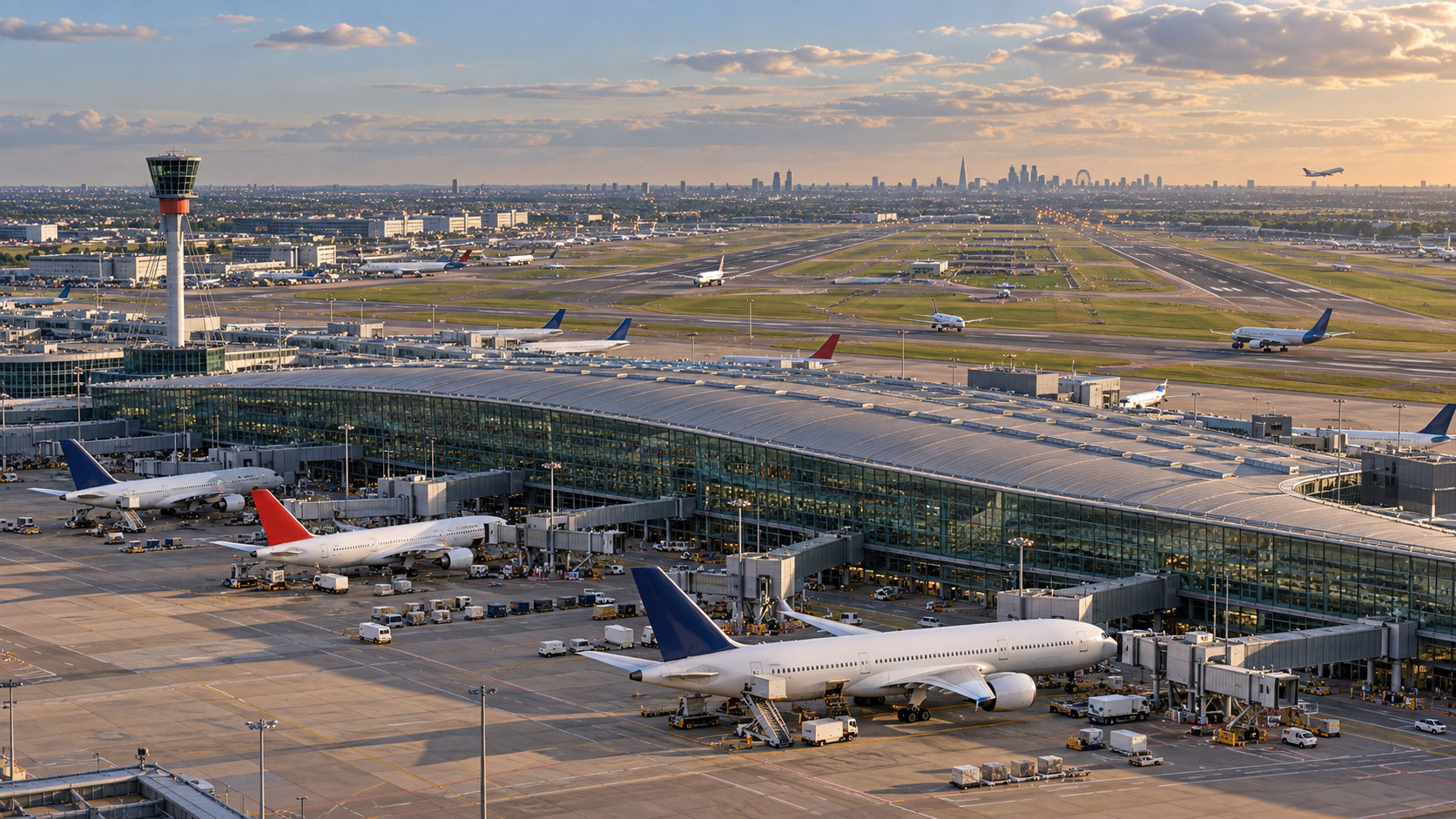
London Heathrow is the UK’s largest airport and one of the country’s principal gateways to the world. Located west of central London, it handles short-haul European flights alongside long-distance services linking Britain with the Americas, Asia, Africa and the Middle East. For many travellers it is a departure point; for others, it is where one flight ends and another begins. Behind those journeys is an airport operating four passenger terminals and two runways within a tightly used site.
From airfield to London Airport
The site’s aviation history began before Heathrow became an international airport. Fairey Aviation established the Great West Aerodrome there in 1929. During the Second World War, plans emerged to develop the area into a much larger airfield. After the war, the site became a civilian airport. Passenger operations began in 1946 under the name London Airport; the Heathrow name followed in 1966.
The first facilities were modest. Passengers used temporary buildings and marquees, a world away from the terminals that occupy the site today. By the end of its first operational year, around 63,000 people had passed through the new airport. As international air travel grew, Heathrow gained permanent buildings, longer runways and the infrastructure needed to handle larger aircraft and more frequent flights.
An airport built around connections
Heathrow’s development followed the growth of commercial aviation. Jet aircraft made long-distance journeys faster, while increasing passenger numbers demanded more space for check-in, baggage, security and aircraft stands. The airport became a major connecting point, allowing passengers to change between flights as well as travel to and from London.
That role influences how Heathrow works. An aircraft may arrive with passengers ending their journeys in the UK and others continuing elsewhere. Airlines need gates, baggage systems and schedules that make those connections possible. Heathrow’s two runways handle a dense pattern of arrivals and departures, while taxiways link them to terminals spread across the airport. The scale of the operation is substantial: Heathrow recorded 84.5 million passengers in 2025.
The terminals passengers use today
Heathrow currently has four passenger terminals: Terminals 2, 3, 4 and 5. The number jumps because Terminal 1 closed to passengers in 2015. Its closure was part of the continuing redevelopment of the airport’s central area.
Each operating terminal reflects a different period of Heathrow’s growth. Terminal 3 traces its origins to the 1950s, while Terminal 4 opened in 1986. Terminal 5 began handling passengers in 2008 and became one of the airport’s most recognisable buildings, with its broad roof and extensive glass frontage. The present Terminal 2 opened in 2014 on the site of its predecessor. Together, the terminals serve a wide range of airlines, but travellers should always check their airline’s current terminal before setting out: arrangements can change.
Reaching Heathrow and flying onward
Heathrow’s position near London makes ground transport an important part of its operation. Passengers can reach the airport by road, coach and bus, or by rail using the Heathrow Express, Elizabeth line and London Underground’s Piccadilly line. The choice depends on where a journey begins, the terminal required and the balance between time and cost.
Once inside the airport, the journey can be more complicated than simply finding a gate. Connecting passengers may need to move between terminals and pass through security before their next flight. Heathrow’s terminals, aircraft stands and transport links therefore function as parts of one larger system. When it works smoothly, a passenger can travel from a city-centre train to an aircraft bound for another continent, or change between two international flights without leaving the airport.
Heathrow’s future
Heathrow has repeatedly rebuilt parts of itself while continuing to operate. New terminals have replaced old ones, aircraft have grown and changed, and passenger numbers have risen far beyond anything its early planners would have imagined. The airport has also proposed further expansion, including a third runway. That proposal has prompted long-running arguments about capacity, economic benefits, noise and environmental effects. It remains a plan rather than an existing part of the airfield.
The contrast between Heathrow’s beginnings and its present scale is striking. What started as an airfield with temporary passenger facilities is now a complex international hub. Its history can be read in the terminals built for successive generations of travellers, while its future will depend on how it balances growing demand with the limits of the space and communities around it.