
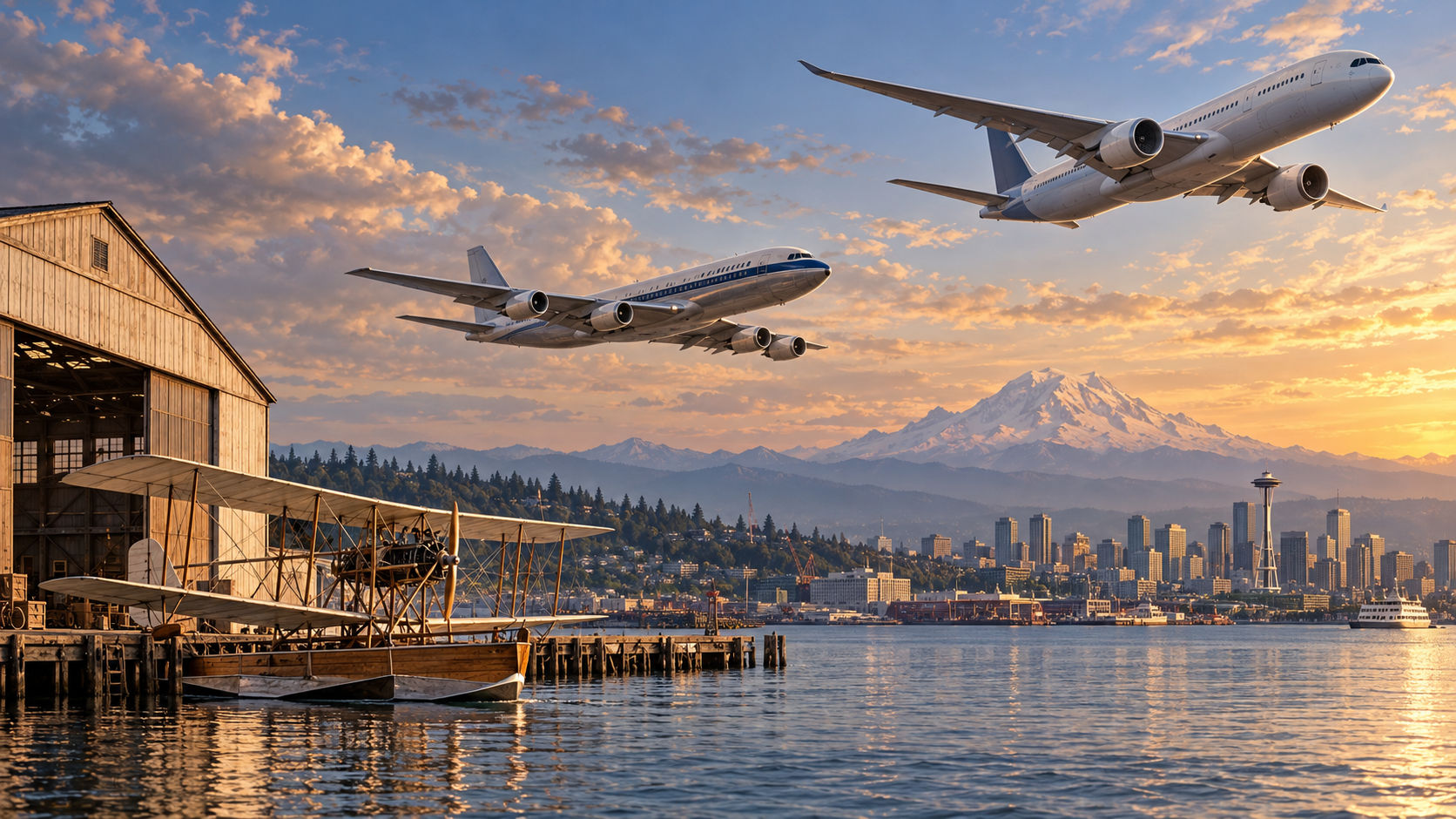
In 1916, an aeroplane was still a fragile, unfamiliar machine to most Americans. William E. Boeing, a timber businessman in Seattle, saw something more durable in it. He had become interested in flying, worked with naval officer George Conrad Westervelt on a seaplane and backed the construction of the B & W. The aircraft first flew in June 1916. On 15 July, Boeing established Pacific Aero Products Company. It became Boeing Airplane Company the following year, by which time the United States had entered the First World War.
Seattle offered useful skills for this experiment. Boatbuilders understood lightweight structures, woodwork and the practical demands of water operations. Boeing drew on local craftspeople and facilities near the Duwamish River to turn a private enthusiasm into a manufacturer. The B & W was a beginning, but founding a company did not guarantee orders. Aircraft were expensive to develop, and the early American market remained small. Boeing needed machines that someone had a reason, and the money, to buy.
Military training created an opening. Boeing’s Model C seaplane, an early design produced for the United States Navy, gave the young company its first significant commercial success. Wartime procurement could support rapid expansion, yet peace brought uncertainty. The end of fighting left manufacturers competing with surplus aircraft and reduced military demand. Like many early aviation firms, Boeing had to find work outside the idea that had sustained it during the war.
The company’s engineers also needed to make aircraft more dependable. An aeroplane built to fly once as a prototype was different from one that a customer could maintain, train on and operate repeatedly. Every order required production methods, reliable parts and people able to correct problems as they appeared. These practical concerns would shape Boeing long after its wooden seaplanes disappeared. They also encouraged the company to look beyond one aircraft type for a stable source of business.
Boeing himself recognised possibilities in carrying mail, a service that could create regular routes and predictable demand. The company explored civilian designs while keeping an eye on government work. That combination of public contracts and commercial opportunity became a recurring feature of its history. The firm founded by one entrepreneur was beginning to take part in a larger aviation system: airfields, pilots, postal officials and passengers would all determine which aircraft succeeded. Airmail would soon offer a way to connect those pieces, and to transform the small Seattle manufacturer into something much larger.
One small detail of the founding story would prove enduring: the company was named for its backer, yet its future depended on a growing workforce of designers, builders, pilots and mechanics. Boeing supplied the capital and direction; they supplied the skills that could turn drawings into aircraft. That combination would be tested as demand changed.
Airmail, Airliners and the Growth of American Aviation
After the First World War, carrying post helped give aviation an everyday purpose. Boeing built aircraft for mail work and moved into the business of operating air routes as well as supplying machines. In 1927, Boeing Air Transport began carrying mail on an important route between Chicago and San Francisco. The operation brought together aircraft, pilots, schedules and ground facilities. It also showed that demand for transport could influence the design of the aircraft themselves: a service needed capacity and reliability, not simply impressive performance on a test flight.
Passenger transport grew alongside the mail. Early travellers often occupied limited space in aircraft whose economics depended heavily on postal contracts. As airliners improved, manufacturers sought cabins and operating characteristics that made carrying people more attractive. Boeing’s Model 80 introduced a larger passenger aircraft to its transport network, while later all-metal designs reflected the industry’s move away from earlier construction methods. Engines, airframes and airport facilities had to develop together before routine travel could appeal beyond adventurous customers.
Corporate expansion followed. Boeing’s businesses became part of United Aircraft and Transport Corporation, a combination linking aircraft manufacture, engines and airline operations. Integration could make technical and commercial sense, but it also raised concerns about competition in the market for government airmail contracts. The Air Mail Act of 1934 forced a separation of manufacturing and airline interests. William Boeing withdrew from the industry, while the manufacturing enterprise continued. The company that made aircraft would no longer control the same airline operation that flew them.
The aircraft programme kept moving. The Boeing 247, first flown in 1933, embodied a new generation of all-metal, low-wing airliner with retractable landing gear. It was an important advance, though competing designs, particularly from Douglas, would reshape the commercial market. Boeing could not assume that technological leadership on one aircraft guaranteed dominance in every succeeding generation. Customers weighed cabin size, operating cost and availability as well as speed.
Boeing also built the 314 flying boat for long-distance ocean routes and the pressurised 307 Stratoliner, which offered a way to fly higher above much of the weather. Both showed the manufacturer’s willingness to explore different solutions to the same basic question: how could passengers travel farther in greater comfort? Neither became a simple template for all future airliners. By the late 1930s, civil aviation was advancing rapidly, but world events were about to change what aircraft factories were expected to produce. Boeing’s experience in large structures and demanding flights would be put to work on a different scale.
This chapter also explains why a history of Boeing cannot be only a list of aircraft. Ownership rules, airline economics and the government’s power to award contracts affected what the company could build and sell. The next change would be even more abrupt: customers who had wanted passenger cabins would soon demand military production above all else.
Bombers, Wartime Production and the Post-war Transition
The Boeing B-17 Flying Fortress became one of the company’s defining aircraft of the Second World War. Developed before the United States entered the conflict, the four-engined bomber was produced in large numbers for demanding operations. Its importance extended beyond the original design office. Manufacturing on a wartime scale required suppliers, workers, tooling and coordinated production at multiple plants. The aircraft’s story therefore belongs as much to industrial organisation as to its missions in the air.
The later B-29 Superfortress represented an even more ambitious programme. It was larger and more complex, with a pressurised crew environment and systems designed for long-range operations. Building and maintaining such an aircraft was difficult, and its wartime use included the atomic bombings of Hiroshima and Nagasaki. Any account of Boeing’s technical achievement has to sit alongside the human consequences of how its military products were used. An aeroplane can be an engineering milestone and an instrument of devastating war at the same time.
War changed the size and skills of the company. Factories expanded, workers arrived in huge numbers and engineering teams learned to solve problems under pressure. These capabilities did not disappear when peace returned, but military orders fell and production had to adjust. Large numbers of trained staff faced an uncertain future. Boeing had to decide which wartime expertise could serve peacetime transport and which capabilities depended on continued defence demand.
The Model 377 Stratocruiser was one answer. Drawing on experience with large, pressurised aircraft, it offered long-distance passenger service in the piston-engine era. It also faced competition from other airliner manufacturers. Boeing’s wartime reputation did not automatically confer success with airlines, which judged purchase prices, running costs, capacity and dispatch reliability. Meanwhile, government customers continued to seek bombers and other advanced aircraft as post-war relations deteriorated.
Jet propulsion changed that calculation. Boeing developed the B-47 and then the B-52, establishing a substantial place in the United States’ jet-age military programmes. The B-52’s long service would make it one of the most enduring aircraft associated with the company. But the jet also offered a possible route back to the passenger market. Boeing would have to invest heavily before it knew whether airlines would buy a new kind of airliner. The next chapter would connect military engineering, airline ambition and an enormous commercial gamble in one aeroplane: the 707.
There was no certainty that airlines would immediately embrace jets. New engines consumed fuel differently, airports needed suitable runways and ground equipment, and an airline buying unfamiliar technology assumed substantial financial risk. Boeing would need to persuade customers that faster journeys could become reliable, profitable scheduled services. Wartime industrial scale alone could not answer that commercial question, however impressive the engineering record had become.
The Jet Age: From the 707 to the 747
Boeing’s 367-80 prototype, often called the Dash 80, first flew in 1954. It helped demonstrate the possibilities of a jet transport and led towards both an aerial refuelling aircraft for military customers and the Boeing 707 for airlines. The related programmes were distinct designs, rather than one aircraft merely repainted for another customer. Boeing took considerable financial risk in pursuing the prototype, but the result gave it a platform from which to compete in the fast-growing passenger jet market.
The 707 entered airline service in 1958 and became central to the expansion of long-distance jet travel. Passengers could cross oceans more quickly, while airlines gained a machine suited to high-volume scheduled operations. Boeing did not invent the jet airliner: the de Havilland Comet had entered service years earlier. Its achievement was to develop a commercially successful aircraft that helped make the jet a familiar part of international travel. Aircraft performance, airline networks and airport investment reinforced one another.
Boeing expanded its jet range for different routes. The three-engined 727 was designed for shorter sectors and airports where an intercontinental jet would have been poorly matched to demand. The twin-engined 737 addressed another part of the short-haul market. Such decisions were about economics as much as technical possibility. Airlines needed the appropriate number of seats, suitable runway performance and maintenance arrangements across their networks. Boeing increasingly became a maker of families of aircraft rather than a single flagship airliner.
The most conspicuous expansion was the 747. Its first flight came in 1969, and it entered passenger service with Pan Am in January 1970. The wide-body aircraft required a vast production facility at Everett and a supply chain able to deliver components on a new scale. Its distinctive upper deck made it recognisable worldwide, but its commercial significance lay in the number of passengers it could carry. Airlines could offer more seats on busy routes, while airports had to accommodate an aircraft larger than earlier jetliners.
The 747 was another major wager. Development costs were high, and filling so many seats depended on airlines’ expectations for future traffic. As the aircraft entered service, Boeing faced the task of building it consistently and supporting fleets around the world. The company had helped reshape air travel twice within little more than a decade, first with the 707 and then with the jumbo jet. Continued growth, however, would require aircraft for routes where a 747 was simply too large.
Behind the dramatic shape of the jumbo jet was a less visible organisational achievement. Engineers, production workers, airlines and suppliers had to agree on thousands of details before deliveries could proceed. The factory itself became part of the programme. Boeing’s future would depend on repeating that coordination across several types at once, not only celebrating one giant aircraft.
The 737, Wide-bodies and a Changing Aerospace Company
The 737 became Boeing’s most recognisable response to short-haul demand. First flown in 1967, it entered service in 1968 and subsequently developed through several generations. Its familiar name conceals extensive changes in engines, wings, flight decks and systems over time. For airlines, a family that could serve evolving networks offered advantages in training and fleet planning, although different generations still required their own approvals and operating procedures. Its longevity also created difficult design choices whenever Boeing sought another substantial update.
Other types filled the space between a small jet and the 747. The 757 combined substantial performance with a narrow fuselage; the 767 offered a twin-engined wide-body for medium and longer routes. Both emerged as airlines were seeking efficient aircraft matched to specific markets. Increasingly capable engines and changing operating approvals helped twins take on routes once associated with larger aircraft carrying three or four engines. Boeing’s product planning reflected how airline economics and engineering advances could change together.
The 777 programme extended that trend. A large twin-engined wide-body, it entered service in the 1990s after a development process involving close consultation with airlines and extensive use of digital design methods. The aircraft showed that high-capacity long-distance travel no longer required the same engine arrangement as the original 747. Boeing now served several overlapping markets, with airlines choosing between capacity, range and operating costs. No single aircraft type could meet every route requirement.
Boeing’s identity was broader than commercial airliners. It remained deeply involved in military aircraft, missiles, space projects and supporting technologies. Acquisitions and partnerships extended its capabilities, while the original Seattle enterprise became one part of a much larger aerospace organisation. Boeing’s own products and those of other firms that would later join it had separate histories. Keeping those histories clear matters: an aircraft associated with today’s Boeing group was not necessarily designed by the Boeing company of its own time.
By the mid-1990s, competition had also changed. Airbus had grown into a major rival in commercial aviation, and airlines could compare competing families across short- and long-haul markets. Boeing had to sustain existing fleets while financing the next generation of products. It also faced the wider aerospace industry’s pressure to combine expensive engineering programmes with a global customer and supplier base. A major merger in 1997 would change the corporation’s scale and inheritance, bringing another prominent American aircraft maker into the story.
The company’s product range was becoming an exercise in balance. A new type might serve a profitable gap, but developing it demanded capital years before deliveries began. Updating an existing family reduced some risks while introducing others as new systems met an older design. Those trade-offs would become especially consequential in the decades after the merger.
The McDonnell Douglas Merger, the 787 and Boeing’s Modern Challenges
In 1997, Boeing merged with McDonnell Douglas. The combination joined Boeing’s commercial and defence operations to a company with its own long lineage, including Douglas airliners, McDonnell fighters and space programmes. It enlarged Boeing substantially, but the aircraft developed by the predecessor companies retained their own origins. A Douglas DC-3 or McDonnell Douglas DC-10 became part of Boeing’s inherited history; neither had been designed in William Boeing’s Seattle workshop.
The 787 Dreamliner represented a different commercial direction in the new century. Boeing designed a twin-engined wide-body for efficient long-distance flying, making extensive use of composite materials and an international supplier network. Its first flight took place in 2009, and the first aircraft was delivered to All Nippon Airways in September 2011. Development and production proved difficult, with delays illustrating how risky it could be to coordinate novel structures, systems and suppliers across multiple countries. Once in service, the aircraft gave airlines new options for long routes that did not always justify the largest wide-bodies.
The company’s recent history also includes grave failures. Two crashes involving the 737 MAX, Lion Air Flight 610 in 2018 and Ethiopian Airlines Flight 302 in 2019, killed 346 people. Investigations and regulatory reviews examined aircraft design, the MCAS flight-control function, pilot information and certification processes. Authorities grounded the type; the United States Federal Aviation Administration allowed its return to service in November 2020 after required changes and review. The losses cannot be treated as a passing interruption in an otherwise uninterrupted success story.
Another serious warning came on 5 January 2024, when a door plug separated from an Alaska Airlines 737-9 during flight. The United States National Transportation Safety Board subsequently found that Boeing had failed to provide adequate training, guidance and oversight to ensure workers followed its process for documenting removal and reinstallation of securing hardware. The finding placed manufacturing discipline and regulatory oversight under renewed scrutiny. Boeing’s stated efforts to improve safety and quality have to be understood against those documented failures, rather than offered as proof that the problems are resolved.
Boeing today develops commercial aircraft, defence products and space systems, with its corporate headquarters in Arlington, Virginia and major aviation operations across the United States. Its history includes transformative aircraft, substantial industrial achievement and decisions whose consequences were devastating. The 707, 747, 737 and 787 each deserve their own type guide; the company story explains the changing organisation behind them. From a Seattle seaplane workshop to a global manufacturer, Boeing’s defining challenge remains consistent: turning complex designs into aircraft people can trust, flight after flight.
Its future will be judged by evidence in production, certification and operation over time. Neither a celebrated past nor a newly announced improvement can substitute for that record. The same public confidence that helped turn early seaplanes into an airline industry must be earned again whenever a manufacturer delivers an aircraft to carry passengers.