Sikorsky is now so closely identified with helicopters that its beginnings as a fixed-wing aircraft maker can be easy to miss. Igor Sikorsky had already designed aircraft in Europe before emigrating to the United States in 1919. In 1923 he established the Sikorsky Aero Engineering Company on Long Island, New York, with the help of a small team that included fellow immigrants. Its immediate challenge was practical: build an aircraft and find customers in a market where successful design offered no guarantee of financial survival.
The team’s early American work centred on the S-29-A, a large twin-engined aeroplane. Producing it required money, materials and persistence from an organisation with limited resources. It demonstrated that Sikorsky could establish himself as an aircraft designer in his adopted country, but the company still needed a product with a stronger commercial future. The opportunity came through aircraft able to operate on water, at a time when suitable runways were scarce along many potential air routes.
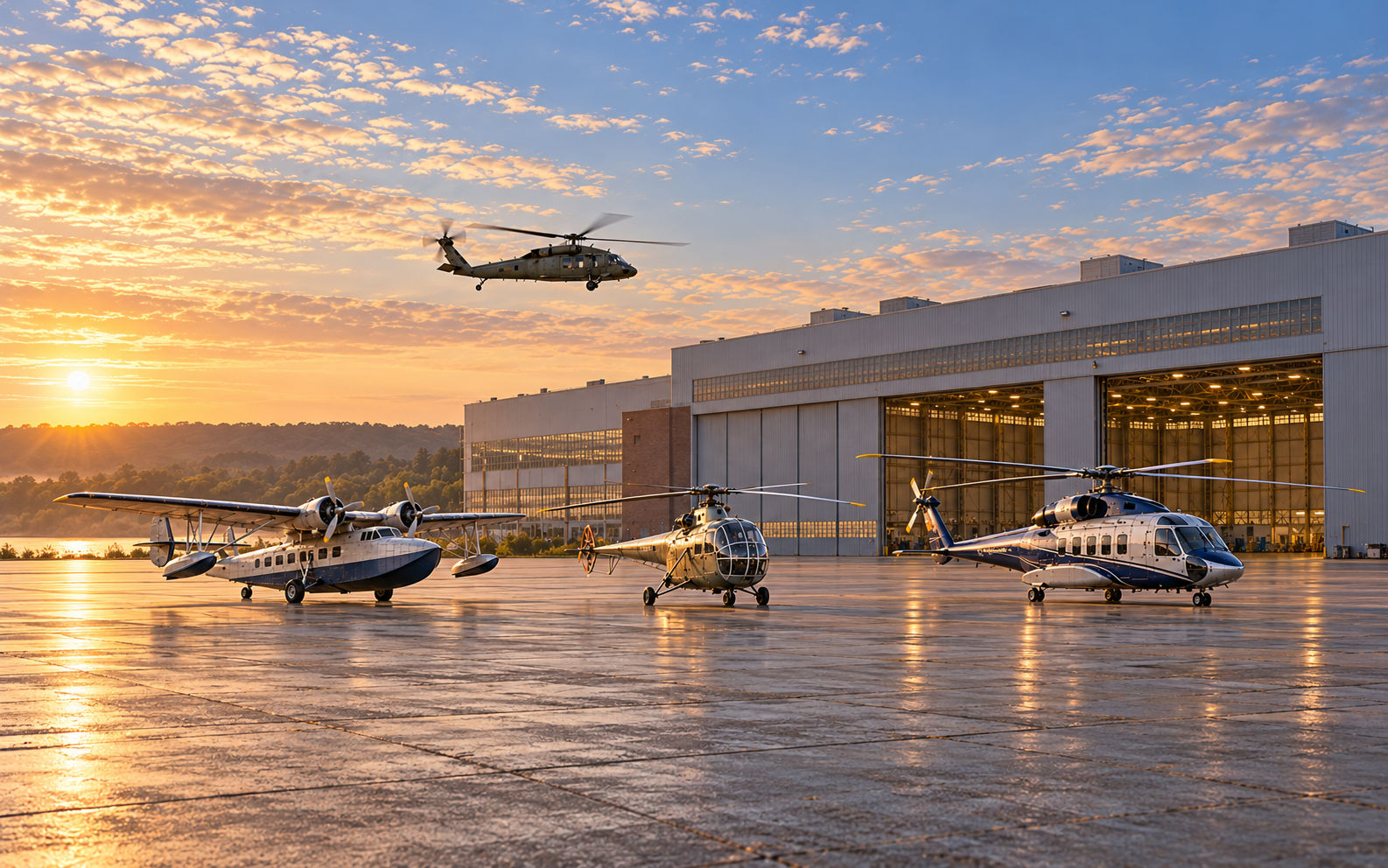
Amphibians could connect places with sheltered water even when permanent airports had not been built. The S-38 became an important early success. It carried passengers and helped serve routes where its ability to use both land and water was valuable. The aircraft’s distinctive shape, with its hull, twin engines and high supporting structure, showed how functional demands could produce a design unlike a conventional landplane. Orders gave the young company a firmer foundation and introduced the Sikorsky name to commercial operators.
In 1929 Sikorsky moved its operations to Stratford, Connecticut, where the name would remain associated with aircraft manufacture for decades. The company became part of a larger aviation business, but its engineering identity survived those corporate changes. During the 1930s, it developed bigger flying boats for long-distance travel. Pan American Airways operated Sikorsky types, including the S-42, on routes that took advantage of harbours and coastal facilities. These aircraft belonged to an era when water appeared to offer a practical way to connect distant places by air.
Flying boats demanded attention to two different environments. Their hulls had to behave properly on water, while their wings and engines had to deliver reliable performance in flight. Long routes required careful planning for fuel, payload, weather and maintenance. That combination of constraints gave Sikorsky experience in solving complicated transport problems, even though the company would later become famous for a very different form of flight.
By the end of the decade, Igor Sikorsky was returning to an idea that had interested him long before the company’s American founding: an aircraft able to rise vertically and hover. Fixed-wing successes had kept the organisation working and developed its engineering resources. The next experiment would ask whether controlled helicopter flight could become more than a brief demonstration.
The VS-300 and the Search for a Practical Helicopter
The VS-300 first flew in 1939, beginning a programme of tests aimed at making the helicopter a controllable and useful aircraft. Vertical lift was not a new dream, and other inventors had built machines that briefly left the ground. The hard problem was producing an arrangement that a pilot could control in hover, transition and forward flight. Sikorsky’s team used the VS-300 as a working test bed, changing its configuration as they learned what the aircraft needed.
A main rotor provided lift, but it also created a turning force on the fuselage. The design needed a way to oppose that force and maintain direction. Control in different axes presented its own difficulties, and early versions of the machine used additional small rotors before the arrangement was refined. Testing was an engineering process rather than a single moment of invention. Short flights revealed how the aircraft responded; parts were altered, and the pilots tried again. Those repeated steps gradually made the machine more predictable.
The VS-300 looked ungainly beside Sikorsky’s large flying boats. Its exposed framework and compact body were appropriate for experimental work because engineers needed access to components and freedom to make changes. The aircraft’s value lay in what it taught about rotor behaviour, power and control. A hovering machine could stop over a chosen point and take off without a runway, capabilities that ordinary aeroplanes could not offer. But to be useful beyond a test site it also had to carry a payload, cover a worthwhile distance and function reliably.
Wartime conditions increased interest in those possibilities. A helicopter might reach people who could not be rescued by a fixed-wing aircraft, or operate where building an airstrip was impossible. The VS-300 was not itself a service transport or rescue machine. It showed that an approach to controlled flight could be developed into one. That distinction matters: the prototype’s experimental achievements were the foundation for a practical aircraft, not evidence that the problems of production and operations had already been solved.
Igor Sikorsky’s role in the programme made him one of the central figures in helicopter history. Yet the work also depended on test pilots, mechanics and engineers who turned observations into design changes. Later accounts sometimes compress this collaborative process into one inspired breakthrough. The surviving record shows a more interesting progression of trials, revisions and increasing confidence in the aircraft’s behaviour.
By the early 1940s, the company had enough experience to turn the helicopter concept towards a military requirement. The move from open-framework test machine to an aircraft that could be manufactured and flown in service would be a major step. The R-4 provided that first large-scale test of whether Sikorsky’s vertical-flight work could operate outside the experimental field.
The R-4 and Helicopters in Wartime Service
The prototype that led to the Sikorsky R-4 flew in January 1942. It developed the practical single-main-rotor, tail-rotor arrangement that became familiar on many later helicopters. Compared with the VS-300, it had to meet the needs of military users: carry people or equipment, survive routine handling and be maintained away from the designers’ workshop. The R-4 was produced in numbers and became an early example of a helicopter moving from experimental promise into operational use.
The Second World War gave it unusual jobs. A helicopter could land in a confined clearing or lift from a place where an aeroplane could not safely operate. That made rescue a particularly compelling application. In Burma in 1944, US Army Air Forces pilot Carter Harman used a Sikorsky helicopter to recover a downed airman and wounded British soldiers from difficult terrain. The mission took repeated flights and was limited by the machine’s payload and tendency to overheat. Its importance lay in showing that vertical flight could make a rescue possible under conditions that had defeated other options.
The R-4 was still a small and comparatively fragile aircraft. Its limited power, range and carrying capacity prevented it from performing many tasks later associated with helicopters. Pilots and ground crews also had to learn a type of flying and maintenance that remained new to military organisations. A successful rescue did not instantly turn helicopters into a mature branch of aviation. It did, however, provide a clear answer to the question of why customers might invest in better ones.
Other wartime uses included work with military services exploring observation, transport and shipboard possibilities. Trials and limited operational employment generated experience that designers could use for larger machines. Each additional task exposed a fresh constraint: how much weight could be lifted, how safely could the aircraft operate, and how readily could it be maintained in the field? The answers shaped the next series of Sikorsky helicopters.
It is useful to be precise about claims of priority. Museums describe the R-4 as an early production helicopter and an important step in making the single-main-rotor arrangement practical. Helicopter experiments existed elsewhere, and different definitions of “first” can obscure that wider history. Sikorsky’s achievement was to turn a controllable design into aircraft that were actually manufactured and assigned demanding work.
The war ended before helicopters could acquire the scale of more established aircraft. Nevertheless, the R-4 had moved the discussion beyond whether a helicopter could fly. Users now had direct evidence of situations in which one could be valuable, and of the shortcomings that needed correcting. They had also learned how much depended on the training and judgement of a crew. Sikorsky’s post-war business would grow by addressing those practical shortcomings for both military and civilian customers.
Expanding Civilian and Military Helicopter Operations
After 1945, helicopter designers faced a different test from the wartime demonstration of possibility. Customers wanted machines that could carry more, fly farther and be used repeatedly without exceptional maintenance. Sikorsky’s subsequent types helped establish the helicopter in rescue, transport and military service. Improvements in engines, rotor systems and cabin arrangements made the aircraft more useful to organisations that needed dependable access to places without runways.
The S-55, whose first test flight took place in 1949, marked an important advance. Its engine was placed in the nose, leaving space for a cabin beneath the main rotor. That layout addressed a basic problem of where to put passengers and how to balance their weight. Military versions served in the 1950s, including during the Korean War. The aircraft showed that a helicopter could carry more than one or two people and could be organised around a clear transport or rescue purpose rather than simply proving its own ability to hover.
Other designs increased capacity and broadened the work Sikorsky helicopters could perform. The S-58 became associated with military and civil transport, while larger types served heavy-lift or specialist requirements. Different versions operated from ships, bases and remote sites. A naval crew needed equipment and procedures suited to salt water and restricted deck space; a rescue team needed to reach and extract people quickly. Those differences produced a range of machines under one manufacturer’s name.
Civil applications also grew. Operators used helicopters for medical transport, offshore support and moving people where roads or airfields were inconvenient. The advantage of vertical flight came with costs: rotorcraft generally demanded careful maintenance, trained crews and thoughtful planning for weather, payload and fuel. Their success did not make conventional aircraft unnecessary. It opened a different set of routes and tasks that aeroplanes could not always serve efficiently.
As the industry matured, Sikorsky had to balance innovation against the confidence customers placed in established designs. A new model could promise a larger cabin or improved performance, but operators also cared about reliability, spare parts and how quickly pilots could be trained. This made the manufacturer’s work extend well beyond a first flight or a sales contract. Supporting aircraft in daily service became part of what it meant to be a helicopter company.
Igor Sikorsky died in 1972, after seeing rotorcraft develop from experimental structures into a recognised form of transport. The company continued within the wider aerospace group to which it belonged, drawing on decades of design and production experience. Its next major military programme would be larger and more capable than the machines that had first demonstrated the usefulness of vertical flight.
By the 1970s, armies expected a utility helicopter to move personnel and equipment under demanding conditions, with an emphasis on robustness and serviceability. Sikorsky’s response would become one of the best-known helicopters in the world: the Black Hawk.
The Black Hawk and a New Generation of Rotorcraft
The helicopter that became the UH-60 Black Hawk was developed for a US Army requirement for a new utility aircraft. Its prototype first flew in 1974. Where the R-4 had demonstrated the possibility of military helicopter operations, the Black Hawk had to function as a practical transport within a modern army. Its design used two engines and was shaped by requirements for carrying troops and equipment, operating in difficult conditions and surviving the demands of regular service.
The Army accepted the first production UH-60A in 1978, and the type entered service in 1979. Moving from prototype to operational fleet again required more than successful flight tests. Crews had to be trained, maintenance procedures established and units equipped to use the helicopter in real missions. The UH-60 offered greater capacity and performance than earlier utility helicopters, but its value depended on how effectively those capabilities could be supported in the field.
Black Hawk versions subsequently served a wide range of roles. Transporting soldiers is the familiar image, yet helicopters from the broader family have also been used for medical evacuation, disaster response and specialist military tasks. Related naval and rescue aircraft show how different customers adapted a common design heritage. These aircraft are connected by their manufacturer and technical ancestry, but they should not all be described as identical UH-60s. Individual variants deserve their own specifications and service histories.
The programme’s longevity came through successive improvements. Later versions received changes to engines, avionics and other systems, while operators invested in keeping existing fleets useful. A manufacturer supporting a helicopter used across many countries must supply parts, address ageing aircraft and respond to evolving customer requirements. Those ongoing tasks are less visible than a new model’s first flight, but they explain how a design can remain in service for decades.
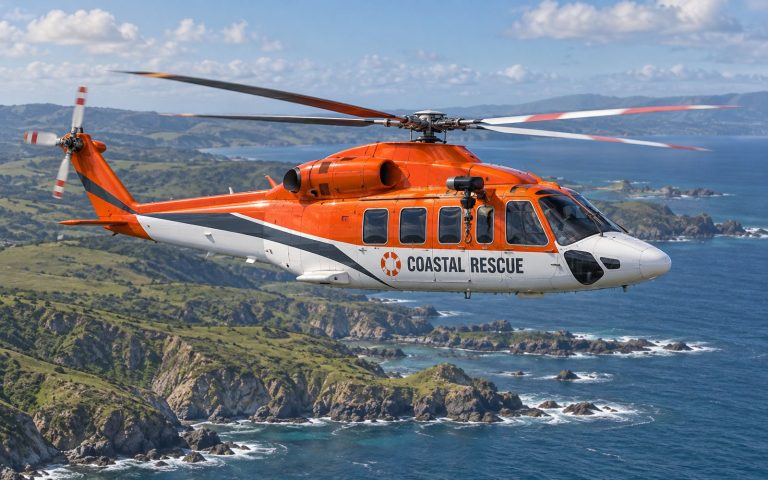
Sikorsky’s work was not confined to the Black Hawk. Its helicopters served maritime, offshore and heavy-lift markets, including designs intended to carry substantial loads or support work far from land. The S-92, first delivered in 2004, brought the company’s name to offshore transport and other civil and public-service missions. These programmes illustrate why even a famous military helicopter cannot stand in for the whole manufacturer’s output.
By the early twenty-first century, Sikorsky had become a major producer of rotorcraft with customers whose requirements differed sharply. A military utility unit, a shipborne operator and an offshore transport company measure success in different ways. The company had to develop aircraft and support systems suited to all of them. Those relationships also required sustained cooperation with suppliers, regulators, military organisations and local maintenance teams wherever helicopters operated. Its next ownership change would place that specialist helicopter business inside a much larger aerospace and defence corporation.
Sikorsky Under Lockheed Martin and Its Continuing Legacy
Lockheed Martin completed its acquisition of Sikorsky on 6 November 2015. The transaction placed a long-established helicopter maker alongside the group’s aeronautics, space and other defence businesses. Sikorsky retained its name as a Lockheed Martin company. That wording is important for historical accuracy: Lockheed Martin did not create the VS-300, R-4 or original Black Hawk. It acquired an organisation with its own earlier designs, workforce and history.
The change in ownership arrived while Sikorsky was still developing new aircraft. The CH-53K heavy-lift helicopter made its first flight in October 2015, shortly before the acquisition closed. Subsequent testing and production took place under Lockheed Martin ownership. The timing makes the boundary between company histories unusually clear: a programme can begin under one corporate parent and continue under another without becoming a wholly new design.
Support for existing fleets remained central to the business. Black Hawk operators needed parts, maintenance assistance and improvements to keep aircraft available. Commercial and public-service customers also relied on helicopters for jobs in which delays or loss of service mattered. Working as part of a larger group did not remove the day-to-day demands of building and sustaining rotorcraft. It gave Sikorsky access to a wider organisation while leaving its products subject to the same tests of performance, reliability and customer need.
The company has also explored technologies for future vertical flight, including systems that can assist or automate aspects of helicopter operation. Demonstrations can be important steps, but they should be described as tests unless a capability has entered routine service. The difference between a promising trial and a proven operational aircraft runs throughout Sikorsky’s history, from the VS-300 to more recent projects. New ideas become significant when they can be used safely and consistently outside a controlled demonstration.
For an aviation guide, Sikorsky is best treated as a manufacturer with a long, continuous identity rather than only as a subheading under Lockheed Martin. Its history spans the S-38 and S-42 flying boats, the experimental VS-300, wartime R-4, post-war transports and generations of military and civil helicopters. Each aircraft reflects a different requirement. Separate guides can follow those types in detail without repeating the entire company story every time.
Sikorsky’s lasting contribution lies in making vertical flight practical for a growing number of tasks. That achievement came through decades of engineering, production and service, with many designers and crews extending the work begun by its founder. Its current place within Lockheed Martin is part of that story, not a replacement for what came before. From waterborne airliners to helicopters used around the world, the company has repeatedly adapted to the places aircraft needed to reach. That adaptability has also shaped how later generations think about the possibilities and limits of flight.