Supermarine did not begin with the Spitfire or even with a conventional land aeroplane. Its origins lay beside the River Itchen at Woolston, Southampton, where Noel Pemberton-Billing pursued the idea of building aircraft that could operate from water. In the years before the First World War, aviation was young enough for an inventor with access to a waterfront workshop to imagine creating a new type of business. Pemberton-Billing established an aircraft enterprise there around 1913; records distinguish those beginnings from its subsequent formal company arrangements. The word “Supermarine” was associated with its aircraft before it became the manufacturer’s familiar name.
Early flying boats promised a practical answer to a difficult question: where could an aircraft take off and land when suitable airfields were scarce? A harbour or sheltered stretch of water offered possibilities, particularly for maritime patrol and travel between coastal destinations. It also introduced complications. A hull had to survive contact with waves while remaining light enough to fly. Engines, propellers and controls had to work reliably in a wet, corrosive environment. Designing a boat that could fly was a considerably different challenge from attaching floats to an ordinary aeroplane.
The young firm’s first projects explored several configurations without guaranteeing a viable product. Money and orders were uncertain, and the outbreak of war transformed demand. Military authorities required aircraft for reconnaissance and coastal operations, but a small workshop could not instantly become a major supplier. Building to another company’s design and undertaking repair work helped develop the production skills and discipline that original designs would need. Hubert Scott-Paine became an important figure in keeping the business moving as Pemberton-Billing’s direct involvement ended.
During the war, Supermarine developed and built seaplanes and flying boats for military needs. These machines were shaped by operational demands rather than by the later image of a sleek racing aircraft. They had to carry crews and equipment, function in difficult conditions and be maintained far from a drawing office. Practical experience with hull construction, structures and flight testing accumulated in the workforce at Woolston. It gave the enterprise a specialism that would distinguish it from many other British aircraft firms.
The company came to use the Supermarine name, and its future lay increasingly in developing aircraft for customers rather than simply pursuing an inventor’s experiments. War orders could not last indefinitely, however. When peace returned, manufacturers faced reduced military spending and competition for civilian work. Supermarine would need aircraft that proved their usefulness in service and designs that attracted attention beyond Britain. The same relationship with water that defined its beginnings would provide both an established market and a stage for an extraordinary series of speed contests.
Those contests would give the workshop a public profile far beyond the scale of its early premises.
Flying Boats and the Race for the Schneider Trophy
In the 1920s, Supermarine developed a reputation for aircraft that could work from water, rather than merely perform for an audience. Its Southampton flying boat entered Royal Air Force service in 1925 and became known for reliability on long-distance operations. Four Southamptons took part in the RAF’s Far East Flight from Britain to Singapore during 1927 and 1928. Such journeys demanded navigation, maintenance and endurance over a succession of stops. They demonstrated what a practical flying boat could achieve, even as a very different branch of the company’s design work drew public attention.
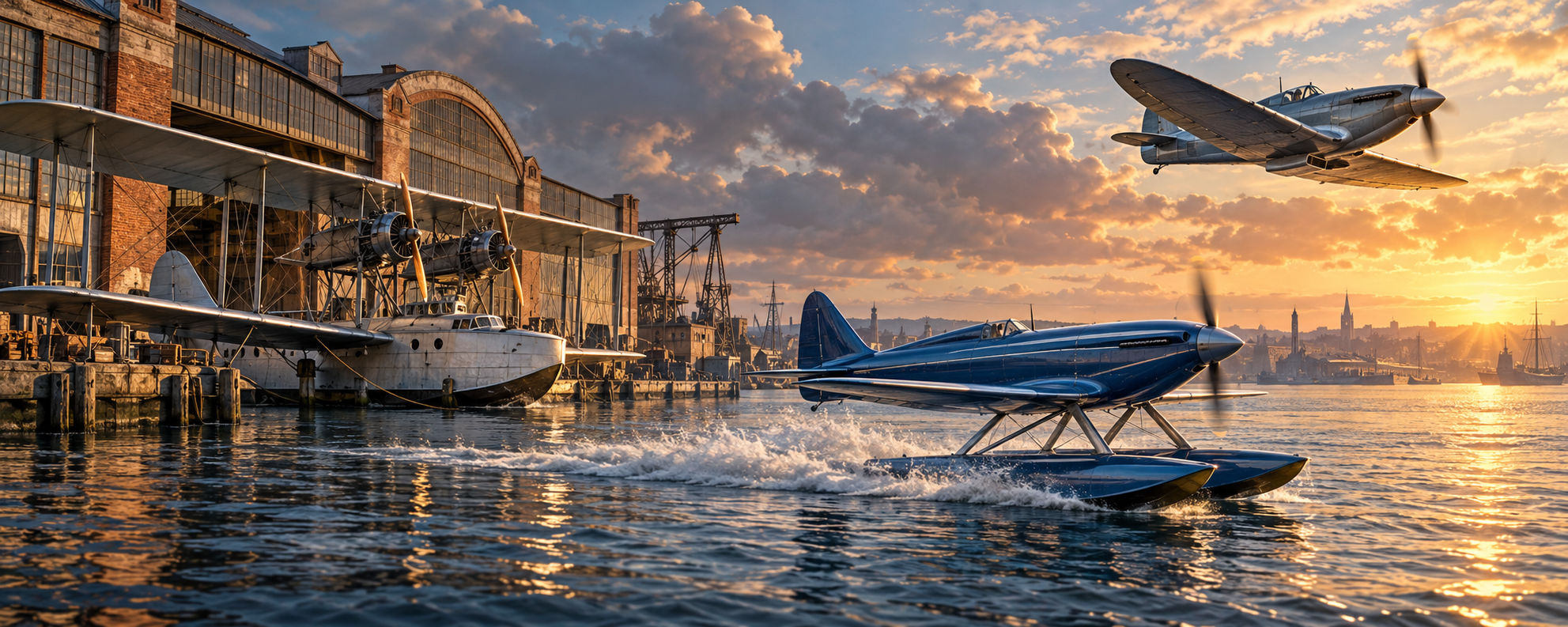
The Schneider Trophy was an international competition for seaplanes, rewarding speed around a set course. It gave manufacturers and governments an incentive to push engines and airframes beyond normal service requirements. Supermarine designer R. J. Mitchell became closely associated with Britain’s racing effort. A competition aircraft had little room for compromise: drag had to be reduced, engine power exploited and the entire machine designed for speed. It was a demanding laboratory for engineering ideas, but a racing victory was not the same thing as producing a reliable operational aircraft.
Supermarine’s S.5 won the 1927 competition at Venice, flown by RAF pilot Sidney Webster. The contest then followed a two-year rhythm. A later Supermarine racer, the S.6, helped Britain win again in 1929. The S.6B won in 1931, giving Britain the three successive victories required to retain the trophy permanently. Its achievement also reflected the work of engine designers, ground crews and pilots; calling the wins the accomplishment of one company alone would miss the collaborative effort behind them.
The contrast with the Southampton is revealing. One type spent months travelling across continents; the other sought the highest possible speed over a short course. Both required a manufacturer capable of building airframes for sustained stresses and of learning from flight tests. Streamlined shapes, careful construction and attention to cooling became increasingly important to the racing programme. Yet an amphibious or maritime background did not simply turn into a fighter design overnight. Skills and people carried forward, while a new military requirement would determine how they were applied.
These were also years of corporate change. In 1928, Vickers-Armstrongs acquired Supermarine, bringing the Southampton manufacturer into a much larger engineering group. The racing programme continued under that ownership, so the 1929 and 1931 victories belong to Supermarine’s design history within the Vickers organisation. With the trophy won and a reputation for speed established, Mitchell and his colleagues faced a more consequential challenge: develop an aircraft for the Royal Air Force that could fight, rather than merely win a race.
A racer could be built in tiny numbers and tended by a specialised team. A fighter needed repeatable manufacture, field repairs and service in weather its designers could not choose. The move between them would test the company more severely than any trophy course.
Vickers-Armstrongs, R. J. Mitchell and the Birth of the Spitfire
Supermarine’s place within Vickers-Armstrongs provided access to a larger industrial organisation while preserving a recognisable design identity. The name Vickers-Supermarine appears in accounts of its aircraft for good reason: the parent company and its subsidiary were closely connected. Mitchell remained central to the design office, but the work depended on engineers, draughtsmen, test pilots and production staff. Turning expertise from flying boats and racing seaplanes into a military fighter required a new answer to the RAF’s changing needs.
One early attempt, the Type 224, did not become the fighter that established Supermarine’s reputation. Its shortcomings made clear that success in the Schneider Trophy could not be transferred wholesale to an operational requirement. A fighter needed armament, pilot visibility, suitable landing gear and performance across a much wider set of conditions than a short race. It also needed to be built in numbers and repaired after hard service. The company used what it had learned to pursue a substantially different design.
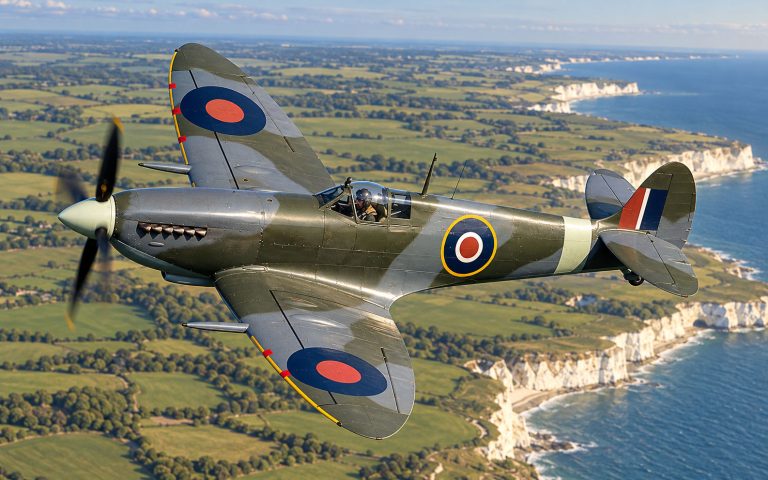
The prototype that became the Spitfire, K5054, first flew on 5 March 1936. Its elegant shape has often encouraged a simple story about one inspired designer, but the aircraft was the product of engineering choices and collaborative development. Its thin elliptical wing, streamlined airframe and Rolls-Royce engine contributed to performance, while the layout needed refinement through testing before production could begin. Supermarine’s achievement was to connect ambitious aerodynamic work to a practical fighter programme, although the journey from prototype to production proved difficult.
Mitchell died in 1937, before the Spitfire’s wartime service. Development continued under the company’s design team, including Joseph Smith. This continuity matters: the aircraft that fought during the Second World War did not remain fixed at the configuration Mitchell first saw fly. Changes to powerplants, structure, armament and equipment would allow later versions to answer new demands. The detailed progression of those versions belongs in the Spitfire aircraft guide, but Supermarine’s ability to continue the work after its chief designer’s death belongs in the company’s story.
The first production machines emerged before the war, and the RAF began receiving Spitfires in 1938. A design with a promising test record now had to pass a more demanding test of manufacturing. Its complex wing and specialised parts required careful organisation at a time when Britain was increasing aircraft orders. Supermarine’s Woolston works could establish production, but the volume required for a large war would exceed one factory’s capacity. The company’s most famous aircraft was becoming a national industrial project, involving many more people and places than its original design office.
Even before combat began, drawings had to become repeatable factory processes. Deliveries depended on subcontractors and on the ability to introduce modifications without stopping the production line. The work was less glamorous than a first flight, but it determined how quickly RAF squadrons could receive the aircraft they had ordered.
Building the Spitfire Through the Second World War
When war began in 1939, Spitfire production had to expand while the aircraft itself kept changing. Supermarine’s original works at Woolston and nearby facilities remained important, but manufacturing spread across a wider network. The Castle Bromwich Aircraft Factory near Birmingham became a major source of Spitfires. Subcontractors made parts, other sites assembled aircraft and production methods adapted to increasing demand. The name on the type did not mean that every airframe emerged from one Supermarine workshop.
Scaling up a fighter programme is not as simple as making more copies of an approved drawing. Parts have to fit when produced by different suppliers. Workers need training, tooling and instructions that reflect each approved change. Engines, propellers, instruments and weapons arrive through separate supply chains. Delays or defects in one component can hold up a completed aircraft. The wartime effort demanded coordinated work among the manufacturer, its parent company, contractors, government authorities and the RAF.
In September 1940, German air raids struck Supermarine’s Southampton works. Dispersed manufacturing helped production continue despite damage and disruption. Moving work into smaller facilities was a practical response to the risk that a concentrated plant could be put out of action. It also increased the challenge of keeping drawings, parts and quality standards consistent across sites. A finished Spitfire represented the work of people who might never have visited the original factory or met the pilot who would fly it.
The Battle of Britain made the Spitfire a public symbol, but Supermarine’s task extended well beyond that campaign. Production continued throughout the war as the aircraft developed for changing roles and operating conditions. Thousands were built, and the work drew on a much broader workforce than the small team associated with the prototype. Public memory often centres on the fighter pilot, while the production story includes machinists, riveters, inspectors, transport workers and engineers who kept aircraft reaching squadrons.
Supermarine was also associated with the naval Seafire, a development of the Spitfire adapted for aircraft-carrier operations. That adaptation brought different stresses, especially during landing, and illustrates why a successful land fighter could not be transferred to naval service without compromise. By 1945, the business had participated in one of Britain’s largest aircraft manufacturing efforts. Peace would sharply change the market again. The company still had aircraft in development and a formidable reputation, but the arrival of jet propulsion meant its next products could not depend on the Spitfire’s formula.
Nor could the company freeze its most famous aircraft while demand remained high. Production versions altered to meet changing threats, and designers had to balance improvements against the disruption of making them. That tension between a working production line and an evolving design was a defining wartime problem for Supermarine.
Seafires, Jets and Supermarine’s Post-war Aircraft
After the Second World War, Supermarine had to find its place in an aviation industry moving beyond piston-engined fighters. The Spitfire’s wartime success was a source of experience and prestige, but a design optimised for a propeller could not simply be fitted with a jet engine and become a modern fighter. Demands for greater speed, new wing arrangements and carrier capability pushed manufacturers to experiment. Orders were also less predictable than in wartime. A prototype could show promise without leading to a long production run.
The Seafire continued to serve the Fleet Air Arm after the fighting ended. Its origins in the Spitfire made it recognisable, but carrier operations exposed the limits of adapting a land aircraft for repeated deck landings. Supermarine also pursued late piston-engined designs intended to improve on the Spitfire. The Spiteful and the naval Seafang showed that aerodynamic development had not stopped in 1945. Nevertheless, the speed of the transition to jets reduced the prospect of these newer propeller-driven designs becoming the company’s next great success.
Supermarine’s Attacker entered Fleet Air Arm service in 1951. It marked a substantial change in propulsion and became the first jet fighter standardised in the service’s front-line squadrons. Carrier aircraft had particular requirements: they needed to take off and land within limited deck space and tolerate the forces of naval operation. The Attacker showed that Supermarine could move into the jet era, though it did not occupy the same position in British aviation as the Spitfire had occupied during the war.
The company also worked on the swept-wing Swift, which entered RAF service in 1954. Its early fighter service was troubled by technical difficulties, and the Hawker Hunter replaced it in that role. A later reconnaissance version had a more useful career. The outcome is a useful reminder that the history of a manufacturer includes projects that failed to meet expectations as well as celebrated achievements. Development of high-speed jet aircraft imposed unfamiliar aerodynamic and structural demands, and competition between British firms remained intense.
The Scimitar brought another Supermarine jet into Fleet Air Arm service later in the 1950s. Its place aboard carriers showed the persistence of a connection to naval aviation that reached back to the company’s flying boats. Yet the industry itself was moving towards larger groups capable of sustaining expensive research and production. Supermarine’s post-war record was varied: it did not cease designing aircraft when the Spitfire left production, but neither did one later type secure its name indefinitely. Corporate reorganisation would soon settle what happened to the separate Supermarine identity.
The difficult results did not erase the expertise behind them. They showed how swiftly the standards for a competitive fighter were moving and why even an established manufacturer needed years of testing. In the jet age, a national industry with many separate design offices faced growing pressure to pool resources.
The End of the Supermarine Name and Its Aviation Legacy
In 1960, the British Aircraft Corporation was formed through a consolidation of major British aircraft businesses, including Vickers-Armstrongs’ aircraft interests. Supermarine’s independent manufacturing identity did not continue as a separate maker of new aircraft. The change reflected a wider problem: development costs were rising while the number of contracts could not support every historic design office as an autonomous producer. A famous name and a record of successful aircraft were not enough to preserve the corporate structure that had made them.
That history can be confusing when older records use different labels. Pemberton-Billing describes the company’s beginnings; Supermarine became the recognised aircraft name; Vickers-Supermarine reflects its later place inside Vickers-Armstrongs. These names belong to successive stages of the same manufacturing lineage. Modern businesses that supply parts for surviving Spitfires should not automatically be treated as the original company revived. A restored aircraft may still fly, but the industrial organisation that designed it belongs to another era.
The Spitfire dominates public memory, understandably, but it does not tell the whole story. The Southampton flying boat shows a manufacturer building machines for long-distance operation from water. The S.5, S.6 and S.6B show its contribution to international air racing. The Seafire, Attacker, Swift and Scimitar record attempts to serve naval and jet-age needs. Looking across those aircraft reveals changing markets and technologies rather than one inevitable march towards a single famous fighter.
The company also illustrates how easily credit can be compressed into one surname. R. J. Mitchell was a crucial designer, yet aircraft were developed, tested, built and maintained by teams. Wartime production relied on factories and suppliers beyond Southampton. The RAF, the Fleet Air Arm, engine manufacturers and government customers helped determine what the company was asked to create. Supermarine’s achievements were real, but they were made within an industry of interconnected people and organisations.
For visitors to an aviation guide, the manufacturer’s name supplies a useful starting point. A Spitfire should be listed under Supermarine because that is the design lineage by which the aircraft is known, while its article can explain Vickers ownership and the wider production network. This manufacturer guide makes space for the rest of the story: a Southampton flying-boat specialist that won racing honours, created a fighter recognised around the world and kept designing into the jet era. The company name disappeared from new production, but the surviving aircraft and historical records still make its work visible.
Museums preserve examples of its flying boats, racing machines and fighters, allowing visitors to see how different these designs were from one another. Their survival also invites a better question than which aircraft was most famous: how did a small waterfront enterprise adapt repeatedly as aviation itself changed?