
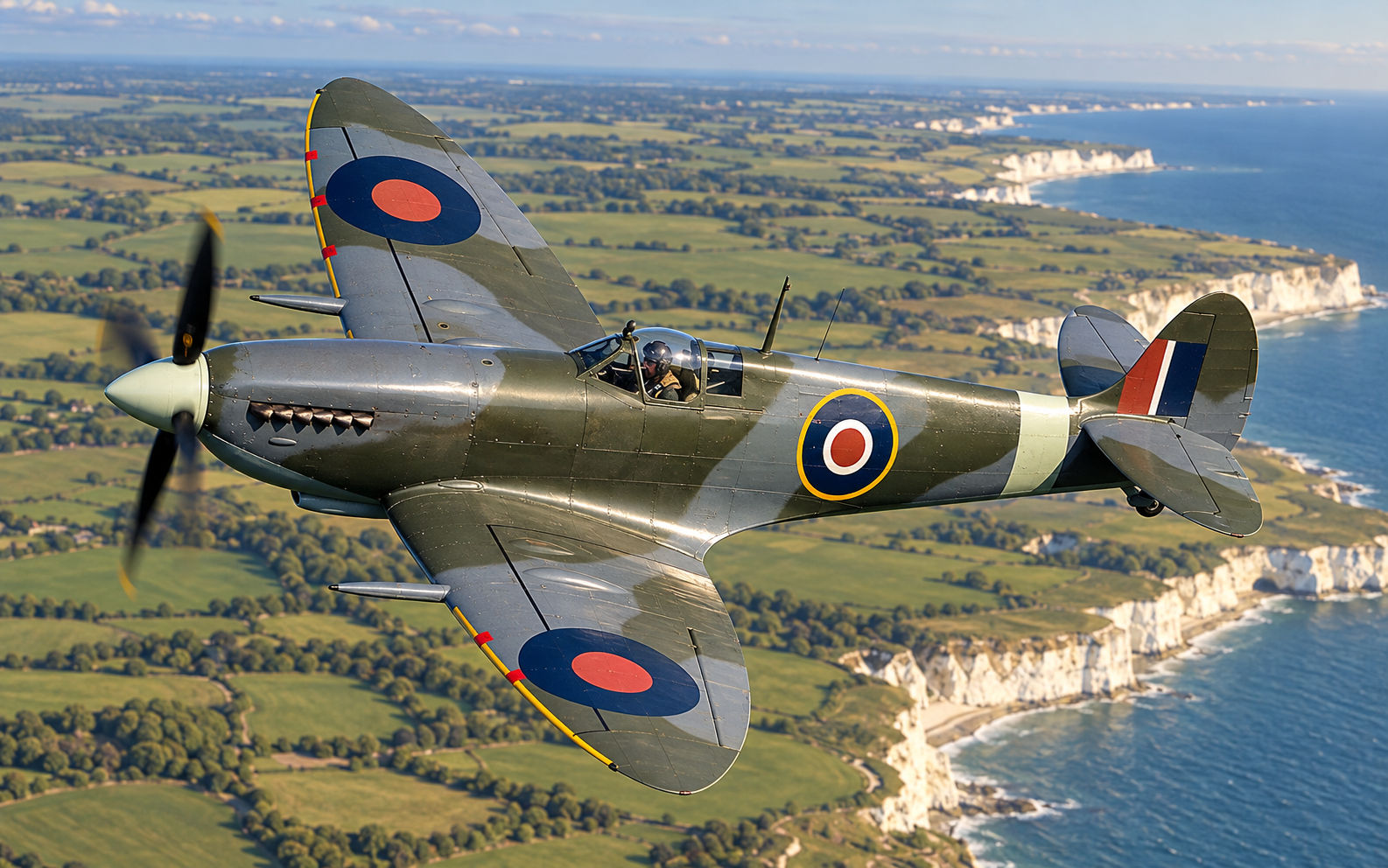
The Supermarine Spitfire began as an answer to a problem facing Britain in the early 1930s. Fighter aircraft were becoming faster, but the Royal Air Force still relied heavily on biplanes. The Air Ministry wanted a modern interceptor capable of meeting an enemy bomber before it reached its target. Supermarine, already famous for its Schneider Trophy racing seaplanes, was well placed to explore the possibilities of a fast, streamlined monoplane. The route to the Spitfire, however, was neither direct nor inevitable.
Supermarine’s first attempt, the Type 224, was built for an earlier fighter requirement. It had a heavy gull wing and a fixed undercarriage, and its performance disappointed. Chief designer R. J. Mitchell and his team went back to the drawing board. Instead of trying to improve that aircraft piece by piece, they developed a different fighter around a cleaner airframe, retractable undercarriage and the new Rolls-Royce Merlin engine. The result was the Type 300, the design from which the Spitfire emerged.
Its most recognisable feature was the slender elliptical wing. The shape helped combine aerodynamic efficiency with enough room for the guns and their ammunition. It was also difficult to manufacture: smooth curves and tightly engineered parts demanded precision from the people who would later build the aircraft in large numbers. The wing was one element of a complete design that included a narrow fuselage, enclosed cockpit and a liquid-cooled engine. Together, they offered a major advance over the open-cockpit fighters that had defined an earlier generation.
The Air Ministry issued a specification to cover the developing design and ordered a prototype. Registered K5054, it took off from Eastleigh, near Southampton, on 5 March 1936. Joseph “Mutt” Summers was at the controls. A first flight could establish that the aircraft worked, but it could not yet prove that it would become a successful service fighter. Further flying would reveal what needed changing in its handling, equipment and performance.
The project soon acquired the name Spitfire. Mitchell, who had led its early development while seriously ill, died in June 1937. His death has understandably become part of the aircraft’s story, but its development did not end with him. Colleagues, particularly Joseph Smith, carried the design forward as a production aircraft and subsequently adapted it to new demands. The prototype’s elegant outline provided the starting point; years of engineering, testing and manufacture turned it into a fighter the RAF could actually use.
The Spitfire therefore grew out of both a failed design and a change in what a fighter was expected to do. It combined racing experience with the practical requirements of military service at a moment when air forces were moving rapidly towards faster monoplanes. In 1936 that promise remained untested in combat, and the challenge of building enough aircraft still lay ahead.
Testing, Production and Entry into RAF Service
After K5054’s first flight, pilots and engineers refined the Spitfire rather than treating the prototype as a finished machine. Changes to its propeller, engine installation and other equipment improved the aircraft as trials progressed. The RAF also had to decide how the fighter would be armed and operated. Early production aircraft carried eight rifle-calibre machine guns, reflecting contemporary British thinking about the volume of fire required in a brief interception. Later fighting would expose both the strengths and the limitations of that arrangement.
The government placed a substantial production order while development was still under way. Turning drawings into repeatable components proved harder than making a single promising prototype. Supermarine’s works around Southampton had experience of specialised aircraft, but mass production required a much larger supply chain, more skilled workers and careful coordination between factories. The wing, in particular, demanded close attention during manufacture. Delays meant that an order on paper did not immediately become squadrons of aircraft on airfields.
The first production Spitfire flew in 1937. As completed aircraft became available, the RAF began replacing older types and learning the new fighter’s characteristics. The Spitfire entered squadron service in August 1938 with No. 19 Squadron at RAF Duxford. Pilots moving from biplanes encountered a faster, heavier and more demanding aircraft with retractable undercarriage and an enclosed cockpit. Conversion involved more than mastering speed: ground crews also needed to maintain a modern Merlin-powered machine and keep it ready to fly.
In September 1938, the Munich crisis showed how little time might be available to expand Britain’s fighter force. Spitfire production became a matter of urgency. The large new Castle Bromwich factory near Birmingham was intended to increase output, although establishing it brought its own difficulties. Meanwhile, work continued at Supermarine and within its network of suppliers. As international tensions increased, the aircraft moved from promising newcomer to an increasingly important part of Fighter Command’s equipment.
When Britain entered the Second World War in September 1939, nine RAF squadrons had received Spitfires. That was a significant beginning, but the type was still far from being the RAF’s only fighter. The Hawker Hurricane was also entering service in quantity and would shoulder much of the coming fighting. The two aircraft had different manufacturing histories and characteristics, and both mattered to Britain’s air defence. The Spitfire’s later fame can make its early scarcity easy to overlook.
At this stage the basic pattern of the aircraft’s future was already visible. Its performance made it valuable, while the pace of production determined how widely it could be used. Testing improved the original design, but every modification had to be built, delivered and supported in service. The coming war would place far greater pressure on that balance between design and supply.
The Battle of Britain and the Expansion of Production
The Spitfire’s first great test came as the air war moved towards Britain in 1940. During the Battle of Britain, RAF Fighter Command had to resist sustained attacks by the German Luftwaffe against shipping, airfields and eventually cities. Spitfire squadrons flew within a wider defence system of radar, observation, command and control. Information about approaching raids helped controllers send fighters where they were needed. The aircraft’s speed and climbing ability mattered, but so did the organisation that put it in the right place at the right time.
The Spitfire is often shown alone in accounts of the battle. In reality, its pilots fought alongside those flying Hurricanes, and the Hurricane accounted for a greater share of Fighter Command’s victories. Spitfires frequently engaged German fighters, including the Messerschmitt Bf 109, while Hurricanes were often directed towards bomber formations. That division was never absolute: pilots met the aircraft they could reach, and the demands of each interception varied. The two British fighters were partners in an air campaign, not competitors for a single heroic role.
Combat exposed the practical demands placed on both aircraft and people. A pilot might receive a warning, scramble, climb towards a raid, fight for a few minutes and then return to refuel and rearm before the next alarm. Damage needed repairing quickly. Squadrons depended on fitters, armourers, radar operators and controllers as well as aircrew. For the Spitfire, changes to the Merlin, fuel and propeller helped improve performance, but reliable servicing and rapid replacement were just as important when losses mounted.
Production itself became a wartime operation. Southampton’s Supermarine facilities were vulnerable to air attack, and bombing forced work to be dispersed among other premises and suppliers. Castle Bromwich, initially slow to get into its stride, developed into the largest producer of Spitfires. Building aircraft at several sites reduced reliance on one factory, although it also made coordination more complex. Wartime output grew because thousands of people converted a demanding design into repeatable parts and complete aircraft.
The battle did not end the air war. Britain survived the immediate threat of invasion, but RAF fighter operations continued and the Luftwaffe remained an opponent. The Spitfire had proved itself an effective interceptor in a national emergency, yet its combat experience also pointed towards new requirements. As German aircraft improved and Britain increasingly carried the fighting across the Channel, the fighter would need more power, different weapons and greater flexibility.
The Battle of Britain established the Spitfire as a public symbol of resistance. That memory is deserved, but it is most accurate when seen in proportion. The aircraft’s contribution depended on a functioning defence network, support on the ground and the efforts of other RAF types. Its wartime story was still in its early stages when the battle ended.
New Engines, New Variants and Changing Wartime Roles
After 1940 the Spitfire faced a changing contest. Improvements to enemy fighters and new operations beyond Britain’s immediate air defence demanded more power and different equipment. The Spitfire Mk V was introduced as a relatively quick answer, pairing an existing airframe with an improved Merlin engine. Produced in large numbers, it served on many fronts. It also demonstrated the limits of an interim solution when German aircraft such as the Focke-Wulf Fw 190 began to challenge it.
Engine development offered a route forward. The two-stage supercharged Merlin in the Mk IX greatly improved performance at altitude, allowing the Spitfire to remain effective against newer opponents. Other marks were tailored for particular height ranges or duties. Armament also evolved from the original all-machine-gun fit towards combinations that included 20 mm cannon. Different wing arrangements accommodated equipment and operational needs; clipped wings, for example, were used on some aircraft to improve handling at lower altitudes. A mark number therefore tells only part of the story: even aircraft of the same broad family could look and perform differently.
The fighter’s work expanded beyond intercepting raids. Spitfires escorted aircraft, supported ground forces and attacked targets of opportunity. Some were adapted to carry bombs, particularly as Allied armies advanced across Europe. Others were converted or built for photographic reconnaissance. These aircraft might sacrifice guns for cameras and extra fuel, using speed and altitude to bring back images of enemy territory. Reconnaissance Spitfires illustrate how the basic design could meet a need quite different from the close air fighting for which it had first been conceived.
Supermarine also introduced the larger Rolls-Royce Griffon engine in later versions. Griffon-powered Spitfires, including the Mk XII and Mk XIV, offered another substantial increase in performance, though the more powerful engine changed aspects of their handling and appearance. The Mk XVI, by contrast, used an American-built Packard Merlin and was closely related to the Mk IX. Production marks did not form a simple straight line in which each universally replaced the last; several versions served at the same time because units and theatres required different capabilities.
The design also led to the Seafire, a naval fighter adapted for operation from aircraft carriers. It belongs to the Spitfire’s wider family story, though the demands of landing aboard a ship make it a distinct subject in its own right. By the closing years of the war, the original 1936 prototype had given rise to a broad collection of fighters and reconnaissance aircraft. That adaptability kept the Spitfire useful long after the first production machines would have been outclassed.
There was a cost to this evolution. More power, equipment and new roles placed demands on an airframe conceived before the war. Its continued relevance came from sustained redesign and production effort, not from a claim that one early Spitfire could do everything its later descendants achieved.
The Spitfire Beyond Britain and After the War
The Spitfire’s operational geography spread far beyond the south of England. As production increased, aircraft were sent to Malta, North Africa, Italy and other theatres where Allied air forces needed fighters. They also served in Asia and the Pacific, where long distances, heat and unfamiliar operating conditions brought different challenges. Spitfires flew with forces from Britain and other Allied countries; the aircraft’s history belongs to an international community of pilots and ground crews rather than to one nation alone.
In the Mediterranean, Spitfires helped defend Malta and later supported the campaign across North Africa and Italy. In mainland Europe, they continued to fly offensive and defensive missions as Allied operations changed direction. The same basic family might be used to protect an airfield, escort other aircraft, investigate enemy positions or support troops. Its wartime record cannot be reduced to the Battle of Britain, however prominent that campaign remains in popular memory.
The end of the war did not immediately end Spitfire production or service. Later Griffon-powered versions remained useful while air forces considered how quickly to replace piston-engined fighters with jets. The final production mark, the Mk 24, was delivered in February 1948. Across its various marks, around 20,351 Spitfires were built. That figure conveys the scale of the programme, although it says little by itself about the differences between an early eight-gun Mk I and a much more powerful late-war machine.
Spitfires continued flying in military service after 1945, including with overseas air forces. Photographic reconnaissance was one role in which the type lasted particularly long. The RAF Museum records the RAF’s final operational Spitfire sortie in 1954, when a reconnaissance aircraft flew in Malaya. By then the aircraft had passed through several generations of development and the RAF’s frontline fighter future belonged to jet aircraft. Its withdrawal was a gradual process rather than a single moment when every Spitfire stopped flying.
Some airframes entered a different life. Museums preserved aircraft as evidence of wartime engineering and service, while private owners and restoration teams returned others to flying condition. Keeping a historic Spitfire airworthy requires specialised skills and careful attention to original components, documentation and modern safety rules. A surviving aircraft’s current markings may represent a particular historical unit, a restored appearance or a later phase of its life; the details need to be checked individually.
The spread of Spitfires across theatres and into post-war service changes how the aircraft should be understood. It was built for Britain’s pre-war air defence, but it became a global wartime tool and remained operational for years after victory. Its preservation now allows people to encounter that history in a way that photographs and statistics cannot fully reproduce. Different surviving marks also reveal how much the original design changed.
Why the Spitfire Remains an Aviation Icon
The Spitfire’s distinctive appearance has helped it survive in the public imagination. Its elliptical wing, long nose and compact cockpit make it recognisable even to people with little interest in aircraft. Film, photography and air displays reinforce that image, often presenting the fighter against an open sky as a symbol of the Second World War. Its design deserves admiration, but the familiar silhouette is also the visible outcome of engineering decisions made to meet a specific requirement in the 1930s.
Its reputation is inseparable from the Battle of Britain. At a moment when Britain’s future appeared uncertain, the sight and sound of a Spitfire came to represent an effective response to attack. That symbolism grew after the fighting and remains powerful. It should not obscure the contribution of Hurricane crews, the wider air defence system or the people who maintained and built both aircraft. A more complete account of the Spitfire makes the achievement clearer rather than smaller.
Longevity is another part of its appeal. An aircraft whose prototype flew in 1936 continued to develop through a world war and to serve into the jet age. A single name covers machines with different engines, wings, armament and duties. The early Mk I, the Merlin-powered Mk IX, the Griffon-powered Mk XIV and the reconnaissance versions show how designers responded to new problems without discarding the underlying concept. Around 20,351 aircraft built across many marks speak to a manufacturing effort as remarkable as the original design.
The Spitfire is also a way into the human history of aviation. Its story includes Mitchell and his design team, test pilots who explored its limits, factory workers who learned to produce complex parts, and crews whose lives depended on the finished aircraft. Those stories stretch from Southampton and Castle Bromwich to wartime bases around the world. No single pilot or engineer can stand for all of them, and the aircraft’s continued prominence offers a reason to explore the work that usually sits outside the frame of a famous photograph.
Airworthy examples add a rare connection between present and past. Hearing a Merlin or Griffon overhead gives an impression of the machine’s power that a static display cannot. Museums, archives and restoration projects provide the accompanying detail needed to understand what is being seen. Every surviving aircraft has its own history, and identifying its mark and provenance is more informative than treating every Spitfire as interchangeable.
The Spitfire remains iconic because its form, performance and wartime role came together at a consequential moment. Its real history is richer than the legend: a fighter that began as an ambitious prototype, evolved under pressure, served in many places and outlived the conflict that made it famous. That combination makes it an enduring subject for an aviation guide—and a reminder that even the most celebrated aircraft is the product of many people, many decisions and continual change.