
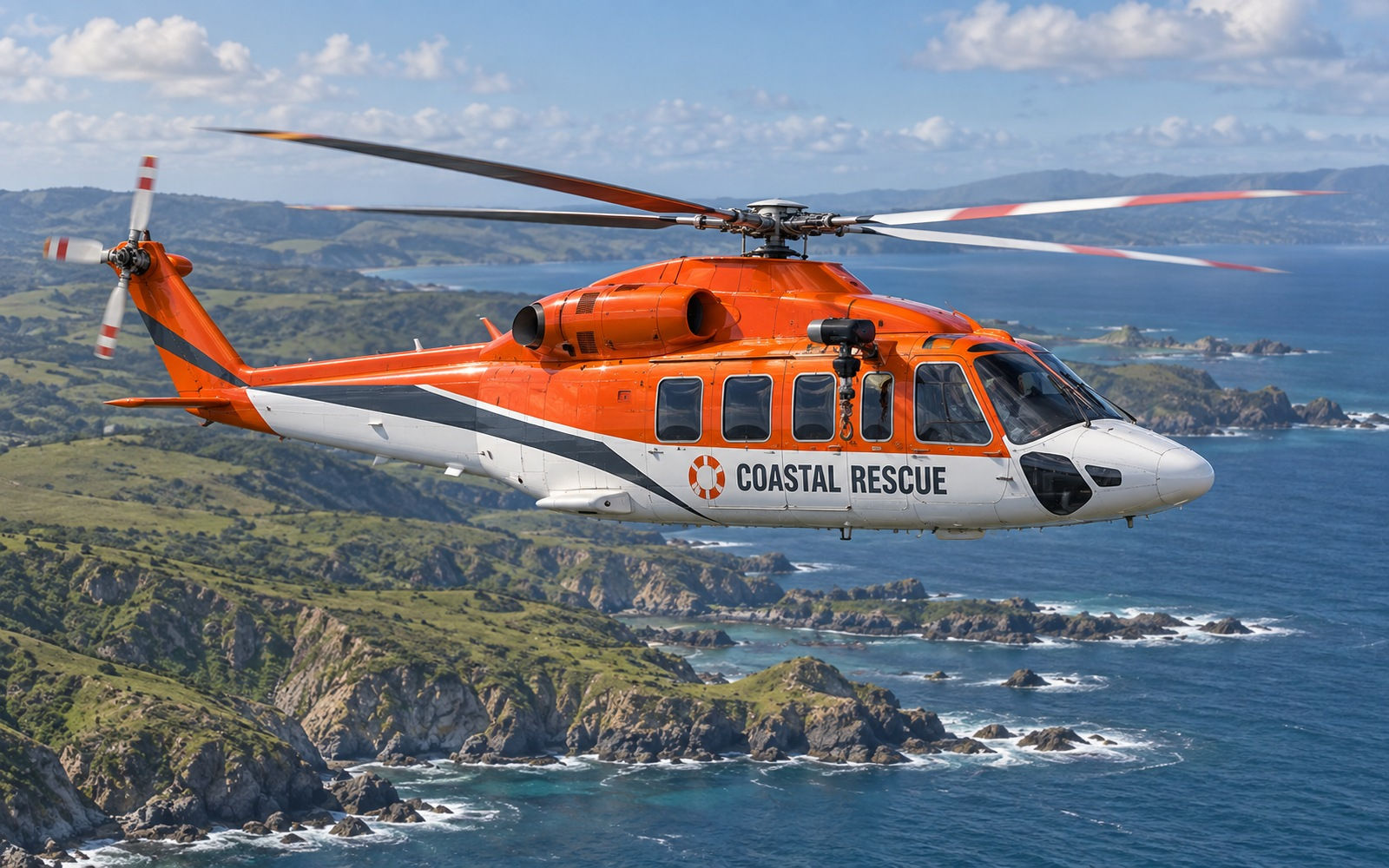
In the mid-1970s, Sikorsky began work on a helicopter aimed primarily at commercial customers. Its military programmes had supplied valuable experience, but operators flying workers to offshore oil installations or carrying business passengers needed something different from an army transport. They wanted a machine able to cover useful distances with a comfortable cabin, dependable engines and a size suited to restricted landing areas. The S-76 was Sikorsky’s response and its first helicopter designed from the outset principally for civilian missions.
The company announced the project in 1975. It envisaged a version carrying twelve offshore workers and a smaller executive layout for around six passengers. Both roles placed demands on the same basic aircraft. Offshore flights might encounter challenging weather and require equipment for operating over water. Corporate customers valued a quieter cabin and a practical journey between locations that did not necessarily have an airport. Sikorsky funded the helicopter’s development and certification from its own resources, making customer demand an important consideration from the beginning.
Engineers could draw on knowledge developed during the Black Hawk programme, but the civilian helicopter was a separate design. Features of the main rotor blades and aspects of the rotor systems reflected that experience. The S-76 had two turboshaft engines driving a four-bladed main rotor and four-bladed tail rotor. Retractable landing gear and a streamlined fuselage helped give it the clean appearance for which it became known. Those choices were not simply cosmetic: drag, vibration and fuel use all affected the cost and experience of a journey.
The passenger cabin was central to the aircraft’s appeal. Sikorsky worked to reduce noise enough for people to converse during a flight without relying on headsets. Seating could be arranged for the mission rather than fixed around one military requirement. A helicopter suitable for flying an offshore crew also needed enough flexibility to carry executives or, with different equipment, patients and medical staff. That adaptability would later open markets beyond the original business plan.
The S-76 was initially associated with the name Spirit, adopted during the period of the United States Bicentennial. Sikorsky later dropped that name, while the model designation remained. The changing label matters less than the underlying departure: the company was treating the commercial helicopter as a major product in its own right rather than a military design offered to private customers with a new cabin.
Design goals still had to survive flight testing, certification and daily use. A fast, attractive prototype would be of little value if it could not operate reliably with the people and equipment its customers needed. The next stage was to turn the promise shown in drawings and engineering work into an aircraft that pilots could fly and operators could place in service.
First Flight, Testing and Entry into Service
The S-76 prototype first flew on 13 March 1977 at Sikorsky’s development flight centre in Florida. A first flight established that the new helicopter could take to the air; it did not prove that it was ready to carry paying passengers. Test pilots and engineers then had to explore its handling, performance and systems across the conditions in which operators expected to use it. They examined the interaction of engines, rotors, transmission and controls while turning a development aircraft into a certifiable commercial type.
Certification was particularly important for an aircraft intended to spend time over water. Operators needed to know what the helicopter could safely do if an engine failed and what procedures crews should follow in poor visibility. The design had to meet the relevant aviation authority requirements before routine passenger services could begin. Features that improved comfort, such as attention to vibration and cabin noise, also had to work alongside the more fundamental demands of safe flight and maintainability.
The US Federal Aviation Administration certified the original S-76 in November 1978. Sikorsky delivered the first production aircraft in February 1979 to Air Logistics in Louisiana, an operator positioned to use helicopters for offshore work. These dates separate three milestones that are sometimes compressed into one: the prototype’s first flight, official approval of the type and the start of deliveries. For a working helicopter, entry into service depended on all three, followed by the training and preparation of the customer’s crews.
The production S-76A retained the key layout established during development: twin engines, one main rotor, a tail rotor and retractable wheeled undercarriage. Its enclosed cabin could be equipped to match different tasks. Pilots found themselves operating a machine intended for regular scheduled work rather than occasional demonstration flights. That meant fuel planning, payload decisions, maintenance checks and turnarounds on the ground mattered as much as the helicopter’s appearance in the air.
The aircraft offered an unusual mix of speed, passenger accommodation and the ability to land close to places without runways. Early customers could judge these claims against daily schedules. A journey to an offshore installation, for instance, required the aircraft to work as part of a wider operation involving weather decisions, passengers, equipment and support crews. A technical feature became valuable only when it improved that complete journey.
The S-76A also gave Sikorsky experience that would shape later versions. Operators reported what they needed from engines, performance in demanding climates and service intervals. The first machines made the S-76 a real commercial product, but the family’s long life would depend on the manufacturer’s willingness to respond to those reports. Expansion in the offshore market soon provided both the opportunity and the pressure to do so successfully.
Offshore Transport and the Growth of the S-76 Fleet
The offshore energy industry became a natural market for the S-76. Crews working at oil and gas installations needed transport between the coast and platforms far from shore. A helicopter could reach those sites directly, provided it carried the necessary passengers and equipment within the limits imposed by fuel, weather and safety procedures. The S-76 had been designed with this work in mind, and its combination of cabin space and twin-engine performance made it attractive to operators building regular offshore schedules.
An offshore flight was more demanding than the simple image of a helicopter crossing the sea. Dispatchers had to account for changing weather, the condition of the destination, required reserves and the weight of passengers and baggage. Maintenance staff had to prepare the aircraft for repeated trips, sometimes from coastal bases far from the manufacturer. The usefulness of the S-76 depended on how reliably it fitted into that system. Its retractable landing gear and streamlined shape helped its efficiency, but effective service required trained people and careful planning.
The type also appealed to operators whose customers valued direct, relatively quiet transport. An executive configuration used the same basic family for shorter groups and a different cabin environment. These flights occupied a separate market from offshore crew changes, yet they helped sustain production and exposed the helicopter to different expectations. Some customers wanted comfort and privacy; others placed greater weight on how many people could be moved efficiently. Sikorsky could adapt the interior without starting an entirely new aircraft design for every assignment.
Additional roles appeared as the fleet grew. Air ambulance operators found that the cabin could accommodate patients, medical equipment and staff, while the helicopter’s performance offered useful reach. Rescue and public-service missions presented other possibilities. These applications did not mean every S-76 was interchangeable. A medical or rescue aircraft needed specialised fittings, training and certification appropriate to its work. They did show that a helicopter designed for commercial transport could serve organisations with more urgent operational demands.
Operating in different climates revealed limitations to address. High temperatures and high airfields can reduce helicopter performance, while heavy loads challenge an aircraft’s available power. Reliability and ease of maintenance influenced whether an operator could keep to a schedule. Feedback from these customers informed the next rounds of engine and equipment changes. Growth brought a larger support task for the manufacturer, which had to help keep earlier aircraft working while offering improvements to new buyers.
The S-76’s expanding role was therefore a story of an aircraft in regular use rather than a series of dramatic record flights. It moved crews to work, carried passengers between businesses and gave service operators another way to reach people. The original design proved flexible enough to justify continued investment. By the 1980s, Sikorsky was developing versions with changes that made that flexibility more useful across a wider range of conditions.
The S-76A, B and C: Improving the Original Design
The S-76 did not remain frozen in its 1979 form. Sikorsky introduced a series of changes responding to customer experience and advances in engines and equipment. The S-76A Mark II, unveiled in 1982, brought numerous improvements aimed at reliability and maintainability. Some changes could be fitted to aircraft already in use. That ability to improve an existing fleet mattered to operators who had invested in training, parts and the day-to-day organisation needed to fly their helicopters.
Later A-series developments included the S-76A+ and A++, fitted with different Turbomeca Arriel engines. More capable engines could help when temperature, altitude or load reduced available performance, but they also brought their own certification and support requirements. A variant designation therefore represented more than a new badge on the fuselage. It could signal changes in power, equipment and what an operator could safely expect under particular conditions.
The S-76B was certified in 1985. It used Pratt & Whitney Canada engines and changes to the structure and transmission that supported higher performance and load capability. The S-76C followed in the early 1990s with Arriel engines and features drawn from the strengthened B-series airframe. Rather than a neat sequence in which all older helicopters vanished, the market contained machines from several generations. Individual buyers selected or upgraded aircraft according to mission, operating environment and budget.
Further C-series changes brought improved engine controls, quieter mechanical systems and attention to engine protection. The S-76C+ was certified in 1996, followed by the S-76C++ in 2006. Electronic engine management helped crews operate increasingly sophisticated powerplants, while changes to filters and the transmission reflected the practical needs of frequent service. Improvements to noise and vibration remained important for a helicopter whose work included carrying passengers who expected a comfortable journey.
These variants also complicate any attempt to give the family one definitive specification. Passenger seating depends on the interior and the number of pilots required for a particular operation. Performance figures vary with engine, equipment, load, altitude and weather. Even when a source gives a figure for a version such as the C++, it should be labelled as that version’s figure rather than applied to every S-76 produced since the 1970s. A family guide is most useful when it explains the pattern of change instead of hiding it behind one set of numbers.
By the end of the 2000s, Sikorsky had spent three decades refining a recognisable basic design. Offshore, corporate and public-service operators had accumulated considerable experience with it. That experience could expose shortcomings in particular climates, changing safety expectations and the economic pressures of repeated daily flying. The next step was a more substantial modernisation intended to offer new equipment and power while preserving the reasons customers had chosen the S-76 in the first place.
The S-76D and a New Generation of Equipment
The S-76D represented Sikorsky’s effort to carry the established family into a new period. It combined new Pratt & Whitney Canada PW210S engines with changes to rotor technology, cockpit systems and equipment. The aim was not to abandon the S-76’s role as a twin-engine passenger helicopter, but to improve what operators could do with it. More capable systems also required extensive flight testing: an upgrade becomes useful only after its behaviour and limits have been demonstrated and approved.
The US Federal Aviation Administration granted the baseline S-76D type certificate in October 2012. Certification for particular equipment and operations followed according to their requirements. This distinction matters for helicopters employed in specialist work. A basic approved aircraft is not automatically ready to carry out every offshore, emergency medical or rescue mission. The customer needs the appropriate installation, trained crews and authorisation for the intended use.
The first S-76D for offshore oil-worker transport was delivered to Bristow in December 2013. In 2014, Sikorsky began delivering aircraft configured for executive and search-and-rescue work. These were different answers to familiar S-76 demands: moving crews, carrying smaller groups comfortably and helping reach people in difficulty. The helicopter remained part of a broad family, although its equipment and engines separated it from the earliest machines by decades of development.
Rescue service provides a useful example of what a configuration means. A suitable aircraft may need search equipment, communications, flotation provisions and a way to recover people, depending on the operator’s assignment. Crews must practise the work and know what the helicopter can do in bad weather or over water. Sikorsky delivered a search-and-rescue S-76D for use by the Japan Coast Guard in 2014, and the type entered that organisation’s rescue operations in 2015. The aircraft’s role rested on the complete operational system, not simply on its paint scheme.
The D version also shows how slowly aircraft programmes can mature. Designers had to integrate new engines and equipment into a known airframe while satisfying certification authorities and prospective customers. Any delay in one element could affect the whole development schedule. Once deliveries began, operators needed spare parts, maintenance information and training suited to the new model. Keeping support for earlier S-76s running at the same time added to the manufacturer’s responsibilities.
The S-76D was certified shortly before Sikorsky became part of Lockheed Martin in 2015. Its development belonged to Sikorsky before that change in ownership; later support continued within the larger group. By then the company was maintaining a diverse fleet spanning several generations, and the question was no longer merely whether the S-76 could find work. It was how operators would keep ageing and newer aircraft reliably available as their missions and the market changed.
Corporate, Rescue and Offshore Service Today
The S-76 family has served a remarkable range of customers since its introduction. Offshore companies have used it to move workers over water; corporate operators have valued direct connections and adaptable cabins; emergency and rescue organisations have equipped it for work where access matters. These missions place different demands on aircraft and crew. A helicopter prepared for executive travel cannot be assumed to have the equipment needed to hoist someone from the sea, even when both share the same manufacturer’s type designation.
Across the family, Sikorsky delivered more than 875 S-76 helicopters, according to figures published by the manufacturer. That long production history created a large community of operators, pilots, engineers and suppliers. The number alone does not measure what the type has achieved, but it helps explain why support for earlier versions remains significant. A machine built many years ago may still be useful if its condition, maintenance and equipment match the work its owner expects it to do.
The market for new aircraft changed. In 2022 Sikorsky stopped taking new S-76 orders while considering other arrangements for future manufacture. That decision should be distinguished from a claim that every S-76 was retired. Existing helicopters continued to fly, and operators still needed parts, technical information and specialised maintenance. The type’s current status is therefore best described as active in service, with new orders halted by the manufacturer, rather than as a single simple label that applies equally to every airframe.
As the fleet ages, individual histories become more important. An S-76A that has spent decades on transport duties differs in condition and equipment from a later D model prepared for rescue work. Upgrades can extend usefulness, but operators must assess their aircraft against current requirements and the availability of trained people and replacement components. The questions of reliability, comfort and support that shaped the original design continue to determine how useful each helicopter remains.
The S-76 also occupies a distinctive place in Sikorsky’s wider story. Lessons from its military rotorcraft work contributed to the civilian design, yet the resulting aircraft was developed for commercial buyers. Over time it reached public-service users as well, showing how a well-planned cabin and evolving systems could accommodate tasks beyond the original sales pitch. Its variants illustrate the way a family of aircraft can change while retaining a recognisable outline.
For readers, the S-76 is more than a sleek helicopter in a photograph. Its history runs from a company-funded commercial proposal in 1975 through first flight, certification and decades of carrying passengers, workers and rescue crews. Different versions should be understood in their own contexts, but they form one continuous story of adaptation. The aircraft remains a useful example of how a civilian helicopter can earn a long working life through successive improvements and support.